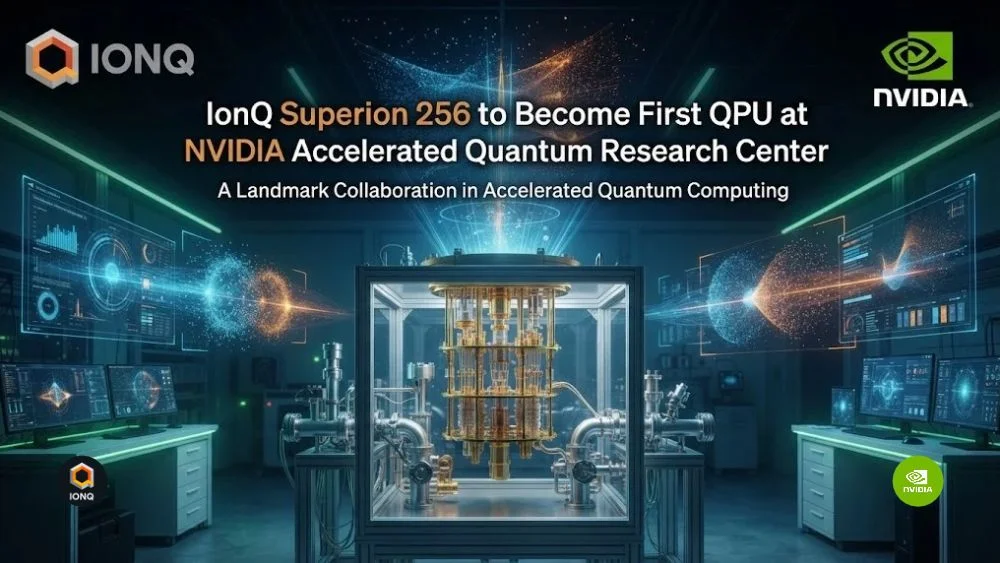
IonQ announced today that its IonQ Superion 256 quantum computer will become the first on-premise quantum deployment at the NVIDIA Accelerated Quantum Research Center (NVAQC). The company made the announcement from College Park, Md. Notably, the NVAQC aims to solve the core challenges of scaling quantum processors. Ultimately, it targets a new class of accelerated quantum supercomputers.
IonQ will connect its full-stack quantum systems IonQ Superion 256 directly with NVIDIA AI infrastructure. As a result, the setup should drive the breakthroughs needed to turn qubits into useful, large-scale quantum supercomputers. These machines could then tackle some of the world’s hardest problems.
How the IonQ and NVIDIA Quantum-GPU Integration Works
Under the partnership, engineers will install an IonQ Superion 256 system at the NVAQC. Next, they will link it to an NVIDIA GB200 NVL72 system through NVIDIA NVQLink. The open NVIDIA CUDA-Q platform will orchestrate the workloads. Moreover, the joint research program will focus on hybrid software development and large-scale system prototyping. It will also generate open results and a guide for future AI use cases and quantum-GPU co-design.
Niccolo de Masi, IonQ Chairman and CEO, explained the strategy behind the deployment.
“Deploying our Superion 256 into cutting-edge environments, such as NVIDIA’s NVAQC will lead to developments allowing our partners to benefit from our scalable architecture and robust manufacturability,” said Niccolo de Masi, IonQ Chairman and CEO. “We see this as the beginning of an exciting era of hybrid quantum-classical computing. This era will be unlocked by multiple generations of Superion systems and NVIDIA’s industry-leading AI platforms.”
De Masi continued, “Our Superion quantum computing platform is robust and research-center ready. Our roadmap to 10,000 qubits and full fault tolerance is accelerating through vertical integration of our SkyWater CMOS foundry. We are excited by the possibilities our groundbreaking partnership with NVIDIA will yield.”
Earlier Research Sets the Stage for Hybrid Quantum Computing
Earlier this month, the two companies published joint research at IEEE Quantum Week. Oak Ridge National Laboratory and the University of Tennessee also contributed to the work. The award-winning study introduced a framework that combines generative AI with distributed quantum algorithms. Consequently, it tackles complex combinatorial optimization challenges. The research ran on the NVIDIA CUDA-Q platform.
Timothy Costa, vice president and general manager for quantum at NVIDIA, also commented on the news.
“Every supercomputer will become a quantum supercomputer,” said Timothy Costa, vice president and general manager for quantum at NVIDIA. “As the first quantum processor to sit alongside the NVAQC’s GB200 NVL72 system, IonQ’s Superion 256 will help make breakthroughs allowing the global ecosystem to integrate QPUs with AI infrastructure, build using open models and open-source software, and advance toward scientifically useful quantum supercomputers,”
Besides quantum-GPU integration, the joint research will target several high-value fields. These include quantum algorithms for portfolio optimization and risk modeling in financial services. Likewise, the teams will explore materials science and computational chemistry for drug discovery. Such complex use cases should benefit from research conducted on the Superion 256 system.
Meanwhile, IonQ introduced its sixth-generation Superion quantum computing platform on Sept. 8, 2026. The Superion 256 system is available to order now. However, first customer deliveries are expected in 2027. Finally, the installation at the NVAQC is scheduled for next year.
Explore IT Tech News for the latest advancements in Information Technology & insightful updates from industry experts!
News Source: Businesswire.com