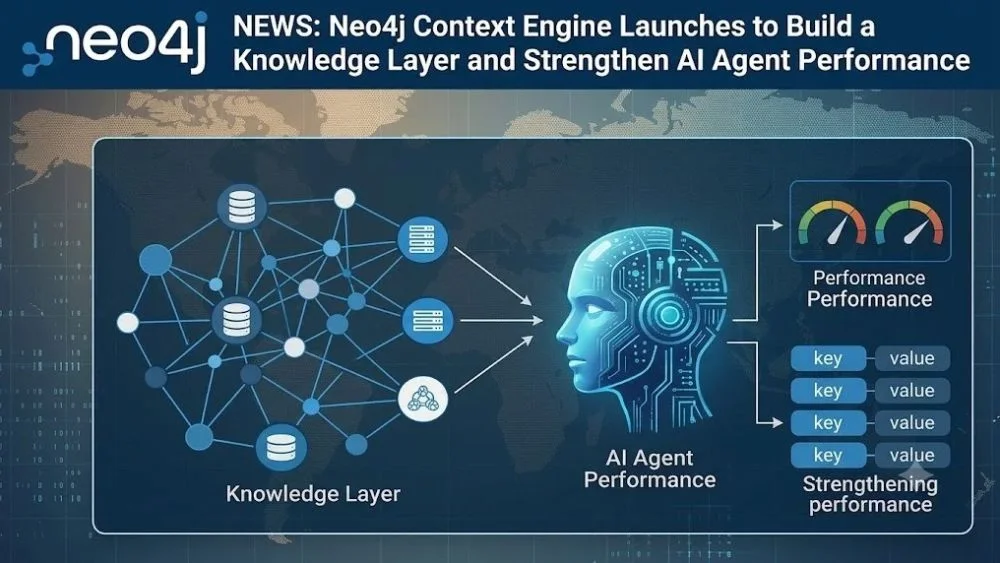
Neo4j, the world’s leading graph intelligence platform, today announced the Neo4j Context Engine. The new product helps companies rapidly create the knowledge layer. This layer works as a re-usable, shared substrate. Agents can use it to reason consistently over enterprise knowledge. Moreover, the Neo4j Context Engine gives AI agents greater meaning, reach, and memory. As a result, those agents become more reliable.
The product forms part of the graph intelligence platform. It creates a shared understanding of business data across systems. Therefore, it enables trustworthy enterprise AI.
Why AI Agents Need Business Context
Data has always had two consumers. Humans understood the relationships between data through institutional and intuitive knowledge. Applications did the same through hardcoded logic. Today, however, data has a third consumer: AI agents. These agents can massively accelerate enterprise operations through automation. Still, they don’t inherently understand what “customer,” “account,” “supplier,” “risk,” or thousands of other relationships and concepts mean within a particular organization.
That meaning often sits scattered across databases, applications, documentation, and individual AI implementations. Consequently, AI lacks the clear map and instructions that the business needs to provide. Agents need the right data, in the right structure, at the right time.
In the August 2026 Gartner® Market Overview for AI Context Platforms, written by Kjell Carlsson, Afraz Jaffri, Christopher Long, and Radu Miclaus, it cites: “Gartner defines AI context platforms as software that enables data and AI engineering teams to construct, govern and deliver semantically organized knowledge to AI agents and other AI applications and services. By treating context as a first-class enterprise asset rather than an agent-by-agent configuration, these platforms separate the life cycle of organizational knowledge from the life cycle of individual agents, increasing the organization’s ability to scale and govern its AI agents across different domains.”*
“Context is what makes enterprise AI reliable and trustworthy,” said Sanjeev Mohan, principal at SanjMo. “But context is not just more data, it’s really about relationships: not just that two things are connected, but why and how. That is exactly what graphs model natively. As agentic use cases get more complex, inferring those relationships is not enough. Organizations need to represent those relationships explicitly, not just guess at them. Done right, that is the context layer enterprise AI runs on.”
“Modeling relationships, and being able to show exactly why and how those relationships exist, is absolutely essential to solving the problem of context for AI. All the other options are a band-aid on the problem that breaks as AI agents grow in complexity and system access requirements,” said Sudhir Hasbe, President of Technology and CPO at Neo4j. “Only Neo4j has decades of expertise using graphs and ontologies to solve complex business challenges. All that expertise will now be available to enterprises through the Neo4j Context Engine.”
The Neo4j Context Engine brings together all the tools and technologies that organizations need. With them, enterprises can give agents context, so the agents stay accurate and explainable. The capabilities include:
Key Capabilities of the Neo4j Context Engine
- Business Ontology: This predefined 6-layer graph model helps enterprises map their organization, business processes, data, and AI assets in Neo4j.
- Proven DesignDefined by Neo4j using industry best practices from hundreds of enterprise customer deployments.
- Seamless Connection The engine links business logic directly to physical data sources. This allows AI and other systems to make context-aware decisions.
- Dual-purpose utility: Energizes first design-time architecture and active run-time execution.
- Build and Runtime Context Enterprises can build the business ontology from existing data sources like Databricks or Snowflake. Similarly, that ontology can be used for process-guided agents or conversational analytics agents in AI orchestration layers.
- Flexible Management. Teams can build and run the semantic layer via headless execution, command line tools or Python packages.
- Wide Connectivity The engine can operate in your existing data platforms, catalogs and enterprise storage systems.
- Customizability and Governance: Complex enterprise requirements are addressed by built-in change management and adaptable frameworks.
- GraphRAG: GraphRAG retrievers retrieve correct context from the semantic layer in a fast way.
- Context Studio: This feature enables teams to control and administrator the business ontology.
- Central Control Plane: Provides a single pane of glass experience to control and monitor the whole environment.
- Ontology and Workflow Builder: Teams can visually define the business ontology and the workflows running on top of it.
- Agent Setup: This feature makes it easy to set up AI agents, model context protocol (MCP) servers, and developer tools.
Explore IT Tech News for the latest advancements in Information Technology & insightful updates from industry experts!
News Source: Businesswire.com