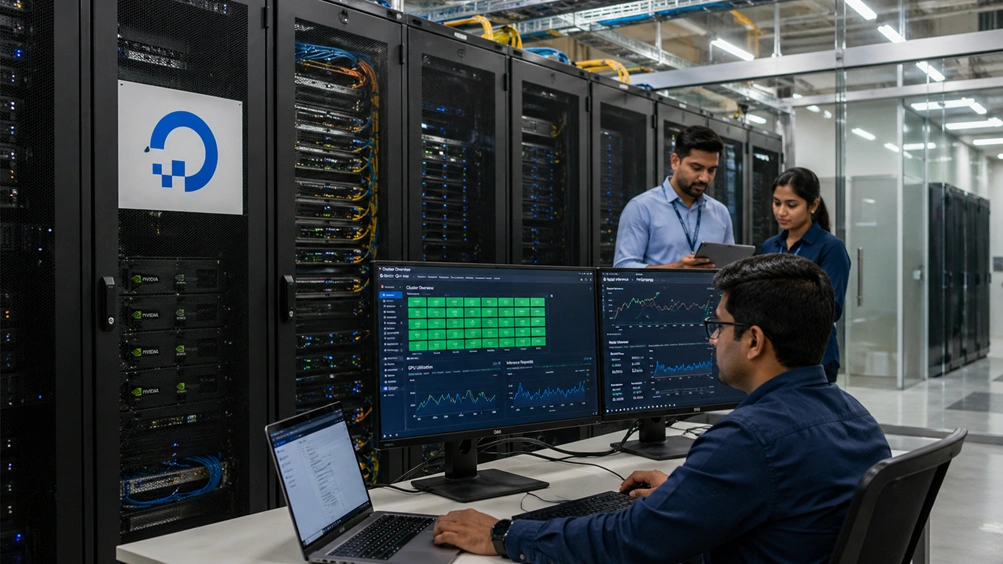
DigitalOcean has officially introduced its new DigitalOcean AI-Native Cloud, a developer-first platform built from the ground up for the inference and agentic era. It brings together five core layers, infrastructure, core cloud, inference, data, and managed agents, into one integrated stack. This setup helps developers start fast, scale production workloads, and improve unit economics without the need to stitch together disparate services. The platform debuted at the company’s Deploy 2026 conference and is available for customers today.
AI workloads have outgrown the cloud of the previous era. Many AI companies today struggle with the complexity of combining fragmented services. They often combine enterprise tools with various separate infrastructure components, such as GPU clouds, which creates a mix of unnecessary costs and complexity. DigitalOcean is aiming to change that. By offering a five-layer integrated platform, they take the heavy lifting out of the process. This allows builders to tap into a broader AI ecosystem and focus on building their AI applications.
Understanding Modern AI Infrastructure
This cloud platform is engineered to address four major shifts in production AI: the rise of inference over training, the move to reasoning models, the need for autonomous agents at scale, and the rise of high-quality, low-cost open-source models. These shifts change what infrastructure has to do. A typical agentic task can consume hundreds of model calls, hundreds of database queries, and over a million tokens. 50% to 90% of that workload runs on CPUs, not GPUs, requiring orchestration, sandboxes, state, and tool calls. Agentic systems consume approximately 4x more CPU capacity than equivalent traditional workloads and 15x more tokens than human users.
By 2030, the world may process over 500 trillion inference tokens daily. Today, that number is about 50 trillion tokens per day. DigitalOcean targets three key workload patterns with its AI-Native Cloud. First, cloud-native SaaS platforms adding AI features. Second, AI-native products where every interaction consumes tokens. Third, agent-native systems that run autonomously in long loops.
The Five-Layer Stack for Production AI
- Managed Agents: Support for open agent harnesses, secure sandboxes, durable state management, and agent orchestration.
- Data and Learning: PostgreSQL with pgvector, Valkey, Knowledge Bases, and real-time data capabilities.
- Inference Engine: Serverless and dedicated endpoints, batch processing, an intelligent model router, a growing model catalog, and bring-your-own-model support, with custom vLLM forks, tuned KV-cache, speculative decoding, and GPU-aware scheduling.
- Core Cloud: Kubernetes (DOKS), CPU and GPU Droplets, VPC networking, and S3-compatible object, block, and file storage.
- Infrastructure: 20 global data centers of CPU and GPU capacity, including owned NVIDIA H100, H200, and HGX B300, and AMD Instinct MI300X, MI350X, and MI355X GPUs on a 400G RoCE RDMA fabric.
DigitalOcean’s analysis of a representative 1M-bookings/month corporate-travel agent workload prices the AI-Native Cloud at $67,727 per month, compared to $84,827 on Baseten + AWS and $110,337 on AWS AgentCore. Those 20-40% savings come with no egress fees between layers and transparent, consumption-based pricing.
Kari Briski, Vice President of Generative AI Software at NVIDIA, shared her perspective on the collaboration:
“Open models are giving builders more choice in how they build AI applications. AI companies need agents that can run continuously and improve over time. Our work with DigitalOcean brings NVIDIA Nemotron models to an open, full-stack platform that gives developers the infrastructure to build, deploy, and scale real-world AI applications more easily,” said Kari Briski, Vice President of Generative AI Software at NVIDIA.
Paddy Srinivasan, CEO of DigitalOcean, emphasized the shift in builder requirements:
“AI has moved from thinking to doing, and that changes what builders need from the cloud. AI-native companies are no longer building simple applications that make a single model call; they are building distributed, stateful, multi-agent systems that need infrastructure, inference, data, orchestration, and agents working together. DigitalOcean’s AI-Native Cloud brings those layers together on one integrated platform so teams can move faster, scale production AI, and focus on their products instead of stitching infrastructure together,” said Paddy Srinivasan, CEO, DigitalOcean.
Finally, Alex Mashrabov, CEO & Co-founder of Higgsfield AI, explained why his company chose this path:
“At Higgsfield, we are building for a world where AI-generated content becomes part of everyday creative work. That requires more than access to GPUs or models; we need an AI-native platform that can support fast iteration, multi-model workflows, and production scale,” explained Alex Mashrabov, CEO & Co-founder, Higgsfield AI. “DigitalOcean’s integrated cloud provides the infrastructure, inference, and simplicity we need to move quickly while staying focused on the creative experience for our users.”
The platform offers a centralized model catalog with over 70 models. It includes open-source and frontier models like DeepSeek, Llama, Qwen, and NVIDIA Nemotron 3 Nano Omni. Customers can combine open and closed models in one application. They can route between models dynamically as needed. They can also switch to new models without rewriting their entire stack.
Explore IT Tech News for the latest advancements in Information Technology & insightful updates from industry experts!
News Source: Businesswire.com