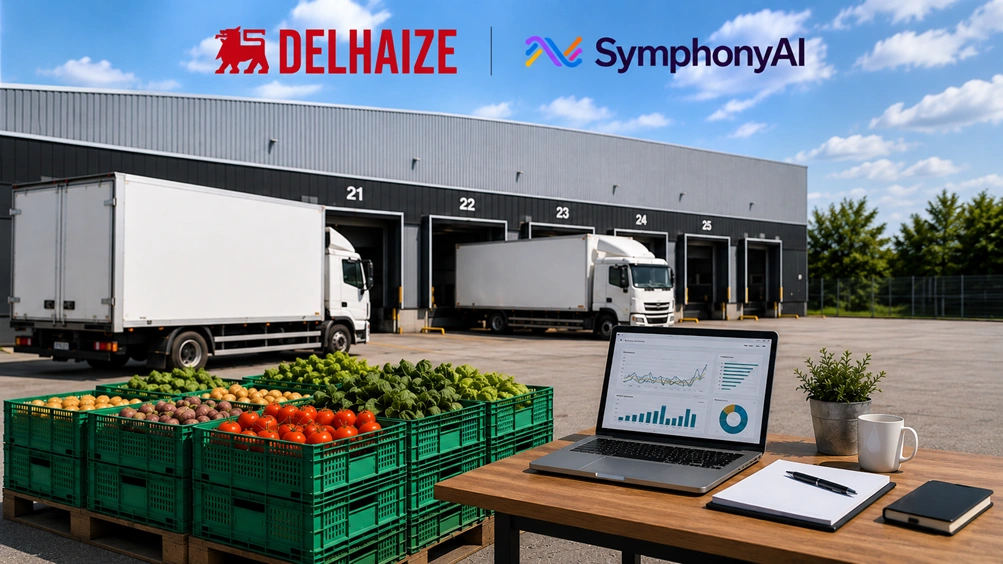
Delhaize has deployed an AI-driven replenishment platform across its 600-store affiliated network in Belgium. The retailer also uses the technology across five distribution centers. SymphonyAI provides the Demand Forecasting and Replenishment solutions powering the deployment.
Delhaize operates as part of the Ahold Delhaize Group. Its pure B2B affiliate model creates a unique inventory challenge. The retailer cannot shift excess inventory to affiliated store partners. Therefore, accurate demand forecasting remains critical across its supply chain. SymphonyAI said the deployment replaces reactive ordering processes with an AI-driven, exception-based workflow. The system supports daily order proposals at distribution center and store levels. It also integrates with SAP Retail.
“We have worked with SymphonyAI for more than 15 years, and the decision to move to their AI-based forecasting models was one we made with confidence.” – Géraldine Durant, Supply Chain Replenishment and Master Data Director at Delhaize
The Delhaize Le Lion / De Leeuw network operates 1,113 stores across Belgium and Luxembourg. The network includes several store formats. These include Delhaize, Proxy, Shop&Go and louis delhaize. Customers can also purchase products through Delhaize’s online platform. They can collect orders from designated collection points or receive home deliveries. Moreover, Delhaize offers more than 20,000 quality products across its assortment.
AI Forecasting Improves Supply Chain Accuracy
SymphonyAI’s AI-driven replenishment platform generates daily order proposals across the network. The system considers several operational factors during replenishment planning. These include vendor calendars, lead times and truck capacity constraints. The platform also accounts for promotional pre-orders and available network inventory. Consequently, Delhaize can make replenishment decisions using broader supply chain data. At the distribution center level, weekly forecast accuracy now reaches 80% to 85%. This performance applies to dry and frozen product categories. Fresh categories now achieve 85% to 90% accuracy.
These figures exclude promotional periods. Meanwhile, affiliated stores have improved forecast accuracy by approximately five percentage points. Highly seasonal locations have achieved improvements of up to 10 percentage points. Across categories, performance has improved by as much as 10 percentage points. Results vary based on product rotation and item type. At the same time, distribution center shrink continues to decline across departments. The improvements have not affected service levels for affiliate partners. Instead, higher forecast accuracy has helped reduce safety stock requirements. As a result, Delhaize has also improved working capital performance.
“Building a best-in-class supply chain on a pure B2B affiliate model is a different challenge than running a traditional retail operation. You cannot push inventory risk downstream to your partners — forecasting has to be right, or you absorb the cost,” said Géraldine Durant, Supply Chain Replenishment and Master Data Director at Delhaize. “We have worked with SymphonyAI for more than 15 years, and the decision to move to their AI-based forecasting models was one we made with confidence. The results across both our distribution network and affiliated stores have validated that decision. We are continuing to improve forecast accuracy each year, and our roadmap with SymphonyAI gives us a clear path to raising the bar further.”
Exception-Based Replenishment Raises Productivity
The move toward exception-based order review has also changed replenishment operations. Previously, specialists needed to validate individual order proposals manually. Now, teams can focus on critical alerts and higher-value supply chain activities. Currently, Delhaize automatically approves around 20% of distribution center order proposals. These approvals require no user intervention. The retailer aims to increase that share to 50% as vendor coverage expands.
Orders requiring manual review also show relatively low modification rates. Dry categories currently record a modification rate of about 10%. Fresh categories record a rate of approximately 20%. These figures indicate the quality of the AI-generated proposals. They also reduce the need for extensive manual corrections. At store level, affiliated store managers review only a limited number of products each day. They use handheld devices to complete these checks. Their reviews focus mainly on high-order alerts and near-empty shelf exceptions. Furthermore, SymphonyAI’s Managed Services team continues supporting Delhaize’s optimization efforts. The retailer currently improves forecast accuracy by approximately 1.5 to 2 percentage points each year.
“Delhaize operates one of the more demanding retail supply chain environments we work in: a multi-echelon network, a high-fresh assortment, and a B2B pull model that removes the inventory buffer most retailers rely on,” said Manish Choudhary, President of Retail, SymphonyAI. “What they have built with our Forecasting AI platform is a replenishment operation that improves continuously, not just at go-live. That compounding accuracy gain is the commercial case for AI in the grocery supply chain, and it is exactly what our platform is designed to deliver.”
Broader Retail AI Strategy
SymphonyAI also provides retailers with additional AI capabilities through its CINDE platform. The platform extends beyond replenishment into other retail intelligence applications. These capabilities cover retail media, assortment optimization and space planning. Forecasting AI determines how much retailers should order and when. In contrast, CINDE focuses on assortment, product placement and shelf monetization. Together, these capabilities can support broader retail decision-making. They also create an AI layer across decisions that directly influence retail margins. Delhaize’s deployment establishes a supply chain foundation for broader retail AI adoption. Meanwhile, the retailer continues working with SymphonyAI to improve forecast accuracy. The ongoing improvements demonstrate the role of AI in grocery supply chain management. They also highlight the growing importance of demand forecasting, inventory optimization and automated replenishment. For Delhaize, the focus remains on improving accuracy while controlling inventory risk. At the same time, the retailer aims to maintain service levels across its affiliated network.
Explore IT Tech News for the latest advancements in Information Technology & insightful updates from industry experts!
News Source: Businesswire.com