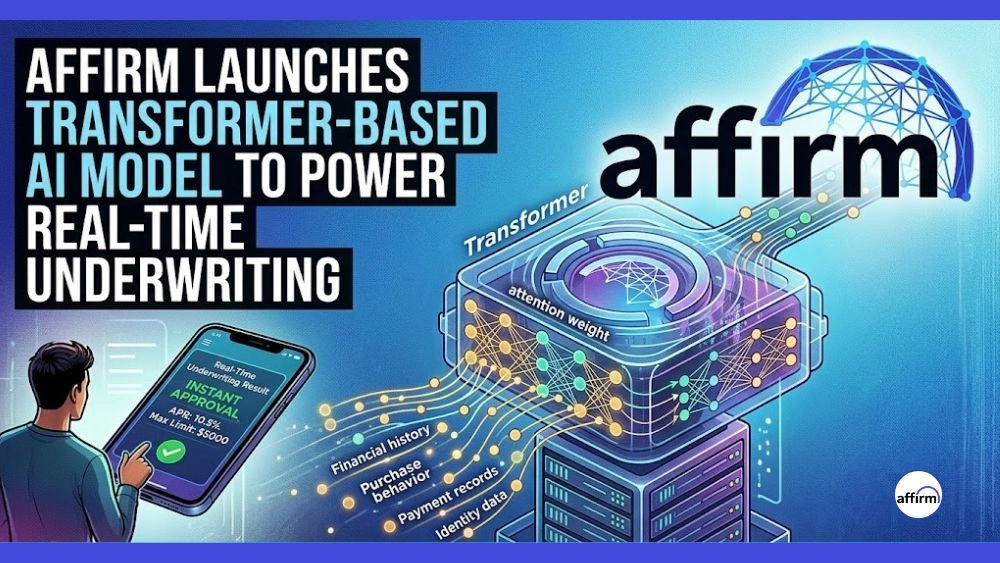
Affirm has unveiled a transformer-based machine learning model built specifically for real-time underwriting. The company has relied on real-time underwriting since its founding 14 years ago. Every purchase still receives an individual decision at checkout. Affirm bases each decision on what a shopper can responsibly repay that day. Importantly, the platform promises no late fees and no hidden charges.
The new model went live at checkout across the United States today. Unlike earlier systems, it learns from the order and timing of events in a consumer’s credit history. Therefore, it captures patterns that static, point-in-time data often misses.
During its initial rollout, Affirm used the model to approve additional eligible applicants. These included shoppers with limited credit histories and no FICO scores. As a result, completed purchases increased by 3.4% compared with a control group. Moreover, the additional loans performed better than expansions built on Affirm’s earlier machine learning models.
“We’ve steadily accelerated the amount of data we use to train each generation of our underwriting models,” said Libor Michalek, Affirm President. “What’s exciting about the transformer model architecture is that we can now find new information within the data we already have. Seeing a credit history more clearly means we can responsibly say yes to more people.”
Finding More Signal in Credit History
Affirm’s underwriting models have consistently improved with each new generation. Each version learns from additional transactions and repayment outcomes. The company has long relied on credit-bureau measures. These include balances, credit utilization, account counts, and payment history. However, those measures only summarize a credit history that keeps changing.
The transformer model identifies patterns within and across credit accounts. It also tracks how those patterns evolve over time. Notably, it does this without requiring a separate measure for every pattern in advance. Consequently, Affirm can extract more signal from data it already holds, strengthening real-time underwriting decisions further.
Built for Fast, Explainable Decisions at Checkout
Building a stronger model was only part of the challenge, though. Affirm also needed the system to remain fast enough for checkout use. So, the company built a proprietary algorithm for this purpose. It delivers the same explainability as Affirm’s traditional machine learning models. Meanwhile, ongoing validation and monitoring keep those explanations accurate and reliable.
“Underwriting is the heart of what we do,” Michalek added. “The goal isn’t to approve every transaction, it’s to make the right decision for each one. We don’t benefit from extending credit that can’t be repaid, which means saying yes to more people only works when we get even better at saying no.”
Ultimately, this launch reflects Affirm’s ongoing investment in responsible, data-driven lending. Real-time underwriting remains central to how the company evaluates risk. Going forward, Affirm plans to keep refining its models. This should help more consumers access fair, transparent credit at checkout.
Explore IT Tech News for the latest advancements in Information Technology & insightful updates from industry experts!
News Source: Businesswire.com