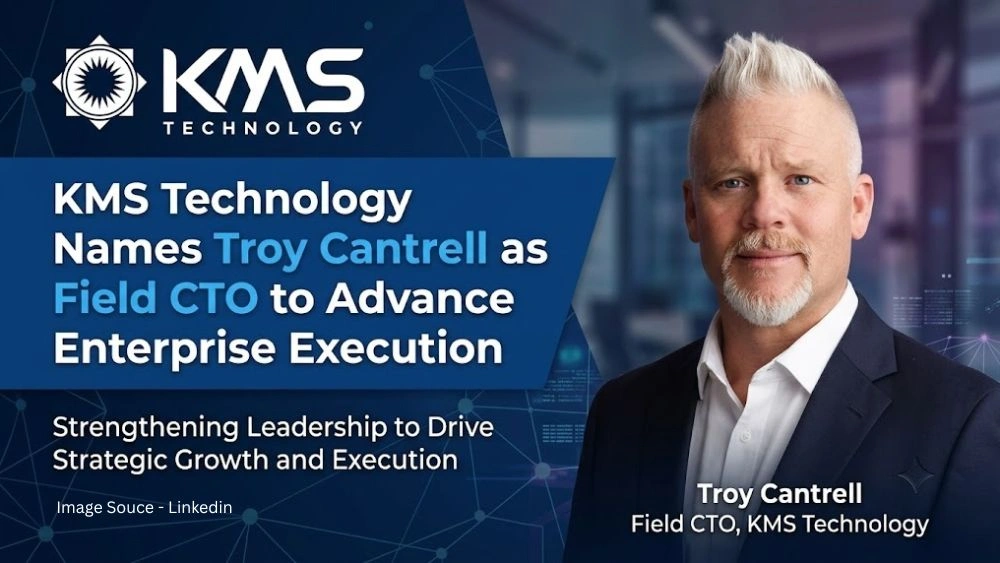
KMS Technology, a global, AI-native technology services company, has introduced Troy Cantrell as its Field CTO. In this role, Cantrell will work directly with enterprise leaders and KMS global delivery teams. Together, they will advance the company’s Enterprise Execution strategy. The strategy turns AI-native ideas into validated, production-grade business outcomes.
“Someone has to own whether AI actually works in production, under real conditions – not just in a demo.” — Troy Cantrell, Field CTO, KMS Technology
Cantrell brings 25 years of enterprise technology leadership to the Field CTO position. His experience spans large-scale ERP programs, ServiceNow implementations, and AI and innovation initiatives. Throughout his career, he has focused on one consistent challenge: accountability for what happens after go-live.
“Across every major technology shift, the hardest work begins after the system goes live,” Cantrell said. “With ERP, the question was whether the business could operate successfully once the implementation team left. With ServiceNow, it was whether people trusted the workflows enough to run their operations through them. AI is the latest and highest-stakes version of that challenge. Someone has to own whether AI actually works in production, under real conditions — not just in a demo.”
His appointment arrives as generative AI dramatically accelerates the creation of code, prototypes, and agentic workflows. However, this speed also introduces new demands around validation, governance, security, and operational reliability.
“AI has made it faster and less expensive to create, but it has not made production readiness easier,” Cantrell said. “The bottleneck has shifted from whether an organization can build something to whether it can execute responsibly at scale. Many enterprises are still structured and resourced for the first problem.”
Cantrell said the frustration surfaces most directly in conversations with security and infrastructure leaders. “I have sat in many conversations with CISOs where they tell me they are tired of paying millions in licensing fees, then being told they are only using 20% of the platforms they invest in.”
Advancing Enterprise Execution
Enterprise Execution is the discipline of turning AI-native intent into reliable, validated, production-ready outcomes. It applies across the entire software and AI delivery lifecycle. Moreover, it unites engineering, quality, governance, and operations as one continuous discipline. Teams no longer treat validation as a final project phase.
Cantrell said that naming the discipline turns it into real work. “When you don’t name a problem, nobody owns it, nobody budgets for it, and nobody measures it,” he said. “Giving it a name turns it into a real workstream with real accountability instead of something everyone assumes will just sort itself out.”
In his new role, Cantrell will work with clients to identify high-value business problems. He will also build outcome-based technology roadmaps. Additionally, he will establish the controls and measurements required to move AI initiatives into production. He will connect insights from client engagements with KMS’s global engineering and delivery capabilities as well.
“A traditional CTO looks inward — one company, one roadmap, one engineering organization to build and protect. A Field CTO looks outward,” Cantrell said. “My role is to understand what is breaking in a client’s business, work with our delivery teams to determine what will solve it, and stress-test our thinking against real constraints, legacy systems, and deadlines. I don’t get the luxury of a whiteboard-only version of the truth.”
Cantrell will also support the continued development of KMS’s Enterprise Execution playbooks. These playbooks guide how teams identify, prioritize, build, validate, measure, and re-engineer work. Defined gates and sign-off apply at each stage. Furthermore, KMS applies these operating practices within its own organization before bringing them into client environments.
“We take ownership at the point where many partners hand over the keys,” Cantrell said. “Creating AI-native work is only part of the job. We are engineers, not just consultants — we think about governance and cost of ownership, and enterprises need a partner willing to stand behind whether it performs safely, correctly, and at scale once it is carrying real business weight. When we take ownership of a client’s execution problem, we are not experimenting on them; we are applying something we have already proven on ourselves.”
Building from Business Outcomes
The conversation changes shape depending on who is in the room. CIOs and CTOs lead with vendor consolidation and total cost of delivery. Chief Data, AI, and Digital Officers press on provable reliability. After all, they defend model behavior to a board. Meanwhile, quality engineering and operations leaders want validation and governance built into the work from day one. They reject the idea of adding these controls at the end.
“The vocabulary changes, but the underlying question is always the same,” Cantrell said. “Prove this works before I bet the business on it.”
Answering that question often begins earlier than clients expect. “Many times clients do not understand what outcome they want,” Cantrell said. “We ask the tough questions up front — what the problems are, where the gaps are, where they are losing in the market — and use that to shape a roadmap toward where the client wants to be in the next five years.”
“Instead of bolting AI onto existing processes, we deconstruct the business process and re-imagine it through the lens of AI,” he said. “If you start with technology, you can end up with a roadmap of interesting capabilities and no clear way to know whether they moved the business. When you start with the outcome and work backward, you can determine what to build first, how to measure it, and what ‘done’ means. That is what makes an AI roadmap actionable and fundable.”
Why Cantrell Joined KMS Technology
The opportunity to work with KMS engineering teams drew Cantrell to the company. Those teams operate across the United States, Vietnam, Mexico, and Poland. Their work extends beyond platform implementation and spans nearly every industry vertical.
“I wanted to work with exceptional teams on some of the toughest problems in business,” Cantrell said. “KMS brings together deeply talented engineers who are passionate about solving problems, not simply implementing technology. That combination gives us the opportunity to help clients move beyond using AI and begin operating as AI-native enterprises.”
Cantrell will work with clients and delivery teams around the globe. He defines success in two parts. First, the industry should recognize Enterprise Execution as a discipline in its own right. It should not become a synonym for AI advisory. Second, KMS teams worldwide should apply the company’s playbooks consistently.
“First we AI ourselves, then we AI the world,” Cantrell said.
Explore IT Tech News for the latest advancements in Information Technology & insightful updates from industry experts!
News Source: Businesswire.com