XCENA has introduced its MX1 production lineup to strengthen Hyperscale AI Infrastructure by addressing memory limitations that affect large-scale AI inference. The company announced the launch while showcasing MX1 at FMS 2026: The Future of Memory and Storage, taking place from Aug. 4–6 at the Santa Clara Convention Center in California. Through this launch, XCENA continues to expand its portfolio of memory-centric computing solutions for modern AI environments.
As generative AI models continue to evolve, organizations require larger context windows and greater KV cache capacity. Consequently, memory has become one of the biggest challenges in Hyperscale AI Infrastructure. Although high-bandwidth memory delivers strong performance, it remains expensive and offers limited capacity. Meanwhile, deploying additional servers often creates unused DRAM resources and increases total ownership costs. Therefore, XCENA developed the CXL-based MX1 lineup to help operators scale memory more efficiently while expanding compute resources. Furthermore, the solution works alongside Intel Xeon 6 platforms to support memory-intensive AI workloads and improve infrastructure performance.
“AI performance is no longer limited by compute, it’s limited by memory, and MX1 is our answer,” said Jin Kim, CEO of XCENA. “By bringing compute to data instead of the other way around, we’re giving operators a way to cut the cost, power and complexity of inference at exactly the moment those pressures are peaking. This is the logical evolution of memory for the AI era.”
MX1 Expands XCENA’s AI Infrastructure Strategy
The MX1 production lineup builds on the earlier MX1P prototype platform that XCENA introduced last year. Currently, the prototype supports proof-of-concept deployments and technical collaborations with customers across multiple regions. Now, the production-ready MX1 lineup enables XCENA to move existing engagements toward production evaluations and commercialization discussions. In addition, the company plans to collaborate with hyperscalers, cloud service providers and enterprise AI infrastructure customers that require scalable memory architectures for demanding AI applications.
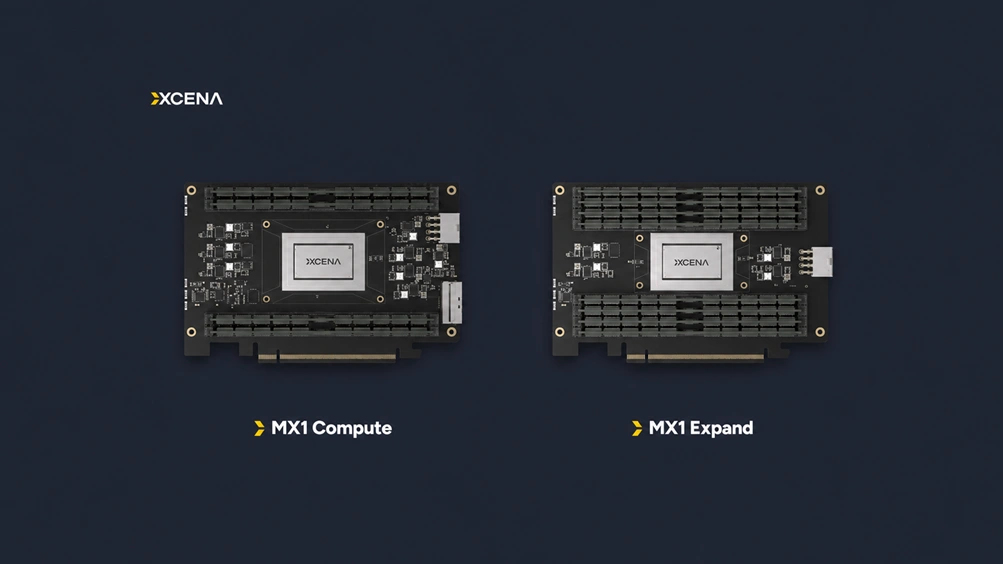
The production lineup includes two complementary products that enhance system performance and memory scalability across Hyperscale AI Infrastructure environments.
MX1 Compute offers CXL-based memory expansion and near-data processing with 2,048 RISC-V cores. This means that the compute resources are collocated with the memory where the data lives. This architecture reduces unnecessary movement of data between the CPUs and the memory. This yields better system efficiency and better AI inference performance. It also reduces power consumption and operational complexity for large-scale AI deployments.
The MX1 Expand provides eight DRAM slots, catering to hyperscalers looking for effective DRAM reuse and server scale-up approaches. It also provides operators with a flexible and cost-effective means of scaling memory capacity across AI infrastructure. This allows organizations to optimize infrastructure investments while supporting increasing AI workloads by increasing available memory resources without excessive hardware expansion.
In summary, the production product portfolio of MX1 reflects XCENA’s ongoing commitment to address the critical memory challenges facing Hyperscale AI Infrastructure. As the need for AI inference grows, the company is looking to enable operators to scale memory solutions that improve utilization, reduce costs and increase overall infrastructure efficiency.
Explore IT Tech News for the latest advancements in Information Technology & insightful updates from industry experts!
News Source: Businesswire.com