Robbyant has unveiled LingBot-VA 2.0, an advanced embodied AI model for controlling the physical world. The company, which is a part of Ant Group, said the new platform is the industry’s first embodied-native video-action world model. This launch is a significant milestone for embodied AI as it exclusively targets robotics and real-world environments, instead of adapting digital content models. Unlike traditional methods, LingBot-VA 2.0 was built from scratch. It meets the demands of dynamic modeling, causal prediction and real time execution. Further, the model is independent of fine-tuned video generation systems built for digital content generation.
The AI industry has been increasingly looking to couple world models with embodied AI. However, many of the current solutions are powered by video generation technologies. Those models are mostly optimized for visual quality and creative output. As such, they often lack robotic execution, physical precision and operational effectiveness. This means that developers often encounter knowledge forgetting and worse generalization during adaptation. Instead, LingBot-VA 2.0 has a different approach to development. The architecture starts with an autoregressive structure. Thus, the model is able to predict how each action will change the environment around it. Then, it takes the next step based on those causal predictions. This results in a more robust decision-making process for robotics.
Robotics Performance Boosted by Fundamental Architectural Advances
Four key architectural innovations were used by Robbyant to build LingBot-VA 2.0. First, we propose a novel visual encoder, the Semantic Visual-Action Tokenizer. This component aligns semantic understanding to action information in the visual compression. Thus the system more effectively translates instructions into completed actions. Second, the platform adopts Strict Causal Pre-training. This autoregressive architecture ensures the action generation and visual predictions are always on a one-way timeline. Therefore, the model is consistent in its reasoning while performing a task.
Third, Robbyant uses a Mixture of Experts (MoE) architecture. This design allows to increase capacity of the model and to keep inference performance efficient. So the system offers a compromise between computation speed and better accuracy. Finally, Enhanced Asynchronous Inference allows for closed-loop control in real-time. While performing current actions, robots can anticipate future states of the environment. In the meantime, they keep refining their next decisions based on new observations in the physical environment.
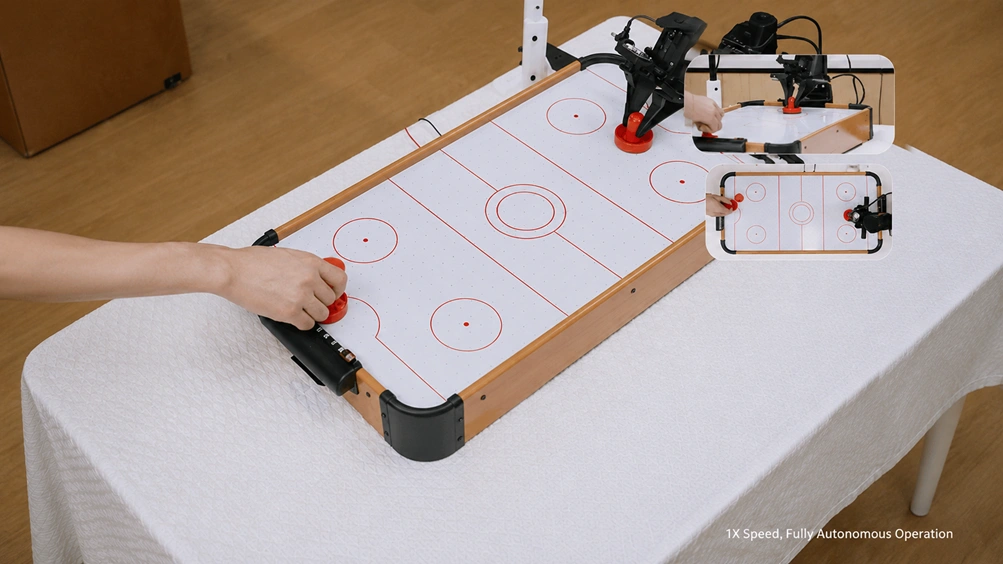
Collectively, these innovations address a major pain point in the industry: the poor execution efficiency of embodied world models. This means LingBot-VA 2.0 can perform real-time inference at 150 Hz on a single GPU. It can also generalize to new tasks after only 20 demonstrations using in-context learning, without any parameter updates.
LingBot-VA 2.0: Robbyant’s Embodied AI Full stack
The release of LingBot-VA 2.0 completes Robbyant’s recently announced embodied-native full-stack. The portfolio comprises LingBot-Depth 2.0, LingBot-Vision, LingBot-VLA 2.0, LingBot-World 2.0, LingBot-Video and LingBot-VA 2.0. In combination, these models enable perception, world simulation and robotic action for industrial and real-world applications.
Zhu Xing, CEO of Robbyant, noted, “Robbyant will continue to explore new limits in embodied intelligence while accelerating the development of an open technology and application ecosystem to expedite robot deployment in industrial and real-world scenarios.”
Explore IT Tech News for the latest advancements in Information Technology & insightful updates from industry experts!
News Source: Businesswire.com