
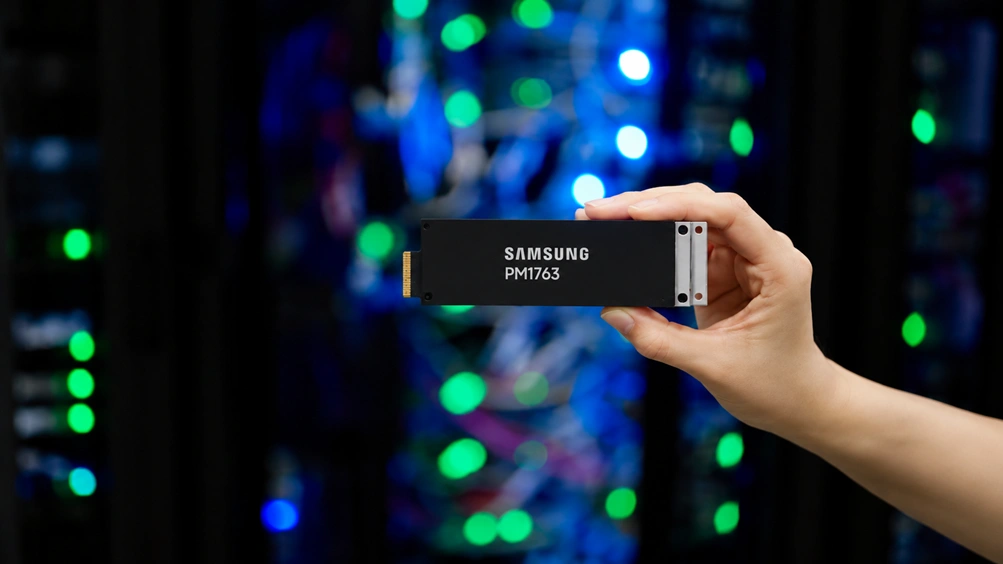
Samsung Electronics is expanding its enterprise storage portfolio for next-generation AI infrastructure and high-performance computing (HPC) environments with the mass production of the Samsung PM1763 SSD. Samsung PM1763 SSD is based on the PCIe® 6.0 interface. It is also built to deliver faster data access, greater efficiency and reliable performance for modern artificial intelligence workloads. The Samsung PM1763 SSD is built to meet the growing demand for AI computing and more complex training and inference operations.
The fast-growing use of artificial intelligence applications has increased the demand of enterprise solid state drives to process and transfer huge amounts of data with low latency. So Samsung created the PM1763 to provide the storage AI servers need. The drive provides a high speed data transfer combined with an optimized controller architecture. This allows organizations to enhance the overall system’s responsiveness, and better support data-intensive applications
“Built on industry-leading performance, PM1763 has successfully completed validation for next-generation AI platforms and is well positioned to support evolving AI infrastructure requirements,” said Jangseok Choi, Vice President and Head of Memory Product Planning at Samsung Electronics. “As AI models continue to grow in size and complexity, PM1763 will serve as a key solution that enables customers to efficiently scale memory capacity and optimize AI operations.”
Samsung’s PM1763 SSD combines the company’s ninth-generation V-NAND technology with a new 4-nanometer controller. This results in the new architecture providing significant improvements in storage performance and power efficiency. These enhancements make the drive ideal for demanding enterprise AI workloads requiring sustained throughput and reliable operation.
Samsung PM1763 SSD Offers Enhanced Performance and Efficiency
Samsung is offering the PM1763 in 4TB, 8TB and 16TB capacities. Additionally, the 16TB model offers sequential read speeds of up to 28,400MB/s. It also has sequential write speeds of up to 21,900MB/s. Samsung claims that this is more than 2x the performance of the previous enterprise SSD, the PM1753. The speedup enables organizations to transfer a 40GB large language model in under 1.4 seconds. That way, processors and AI accelerators can get to the data much faster. Moreover, lower latency improves overall efficiency of AI processing across enterprise workloads.
Samsung also enhanced the PM1763 for liquid-cooled server environments by incorporating direct-to-chip (D2C) cooling technology. Therefore, the drive can operate at its maximum during large workloads without sacrificing operational stability. Samsung says the PM1763 improves power efficiency by more than 1.8 times compared with its predecessor. Lower power consumption can help enterprises reduce datacenter operating costs while allowing for larger AI deployments.
Advanced Security Powers Future AI Infrastructure
In addition to performance improvements, Samsung has enhanced the security features of the PM1763 to meet the changing requirements of the enterprise. The drive supports post-quantum cryptography (PQC) algorithms, which help organizations prepare for future quantum computing threats.
The PM1763 also supports the TEE Device Interface Security Protocol (TDISP) . This technology helps secure data pathways in virtualized environments. This helps organizations better secure sensitive workloads across AI infrastructure and enterprise server deployments.
Samsung says the PM1763 is an enterprise SSD that combines PCIe 6.0 performance, advanced cooling support, improved efficiency and enhanced security to meet the growing demands of next generation AI and HPC platforms.
Explore IT Tech News for the latest advancements in Information Technology & insightful updates from industry experts!
News Source: Businesswire.com