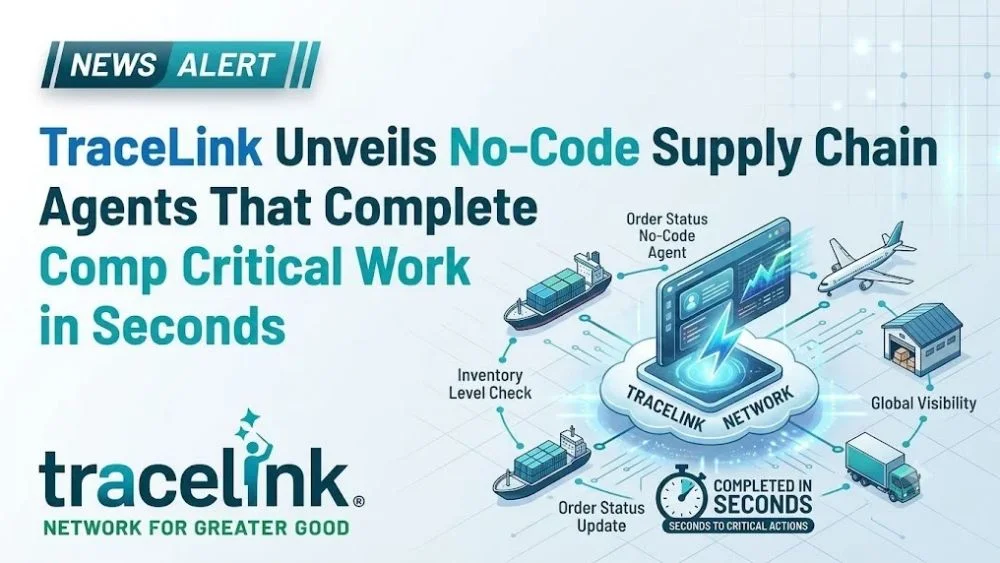
TraceLink, the world’s largest Agentic Business Network, today announced a breakthrough in no-code supply chain agents. The new capabilities change how OPUS Agents handle critical supply chain work. The OPUS Brain, TraceLink’s intelligence and reasoning layer for OPUS Agents, powers them. It converts agent instructions into optimized, verifiable Semantic Inference Plans (SIPs). As a result, OPUS Agents complete recurring work in seconds, with greater reliability and consistency.
Moreover, enterprises can now inspect, test, and approve agent plans before production. no-code supply chain agents They can also identify changes that could affect agent performance. In addition, they can measure completed work through operational records and Agentic Business Process dashboards. These capabilities address critical barriers to scaling agentic operations. Consequently, companies gain greater confidence, accountability, and cost visibility as they expand governed OPUS Agents throughout supply chain processes.
“For enterprise processes, agents have to be governed, reliable, fast, specialized, and perform work at predictably low cost,” said Shabbir Dahod, President and CEO of TraceLink. “Our innovations achieved all those goals. With these breakthroughs, TraceLink is bringing a new level of intelligence and operational capacity to global supply chains, enabling companies to manage greater complexity, expand the work they can perform, and drive growth in ways that were previously beyond their reach.”
Optimized Plans Power Faster, More Reliable OPUS Agent Performance
Traditional AI agents often repeat complex reasoning each time they encounter a similar business event. This habit increases processing time and cost. It also raises the potential for inconsistent results.
Each SIP defines an intended approach for achieving an OPUS Agent’s Objective. It draws on approved Tasks, Decisions, Rules, and operational context. The OPUS Brain generates, evaluates, and recursively optimizes these plans to improve speed and accuracy. Meanwhile, human teams can inspect, test, and approve them before production use. Once approved, optimized SIPs guide recurring agent work. Therefore, processing delays shrink, and agents respond faster to changing supply chain conditions.
Verifiable Work and Measurable Business Value
Evaluation Logs show how agent work compares with an approved SIP. They support inspection, validation, and refinement. Likewise, Progress Logs track the progression of work. no-code supply chain agents Work Logs capture completed activities and their business context. Outcomes then document the resulting business results. Together, these records establish the evidence needed to assess agent performance, maintain accountability, and improve Agentic Business Processes over time.
Furthermore, versioned Agent Profiles associate each OPUS Agent with a specific operating definition. Companies therefore control when updated instructions, policies, or requirements take effect. Dependency tracking also flags changes to Agent Profiles, Processes, Business Objects, Rules, and configurations. Such changes may require additional evaluation or retraining before they affect agent behavior. Thus, these controls help enterprises maintain reliability as business requirements and supporting systems evolve.
Work Logs and Agentic Business Process (ABP) dashboards give organizations visibility into operational activity. With them, teams can evaluate productivity, work quality, and business results.
Finally, no-code supply chain agents pricing charts and cost dashboards reveal agent operating expenses. They help companies build more predictable financial models for individual Agentic Business Processes. By comparing costs against measurable outcomes, business leaders can assess the value of agentic operations. They can then prioritize investments accordingly.
Explore IT Tech News for the latest advancements in Information Technology & insightful updates from industry experts!
News Source: PRNewswire.com