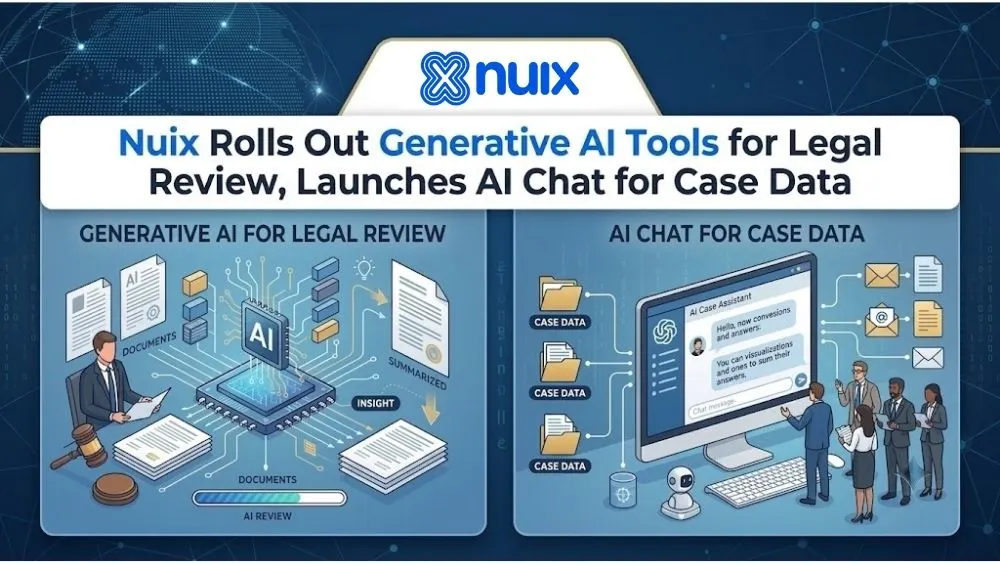
Nuix has officially launched its Generative AI capabilities within Nuix Discover SaaS. The company confirmed general availability on September 4. Consequently, legal teams now gain access to Document Summaries, Similar Documents, Semantic Search, Clustering, and Visualizations. These tools directly enhance the platform’s eDiscovery and legal review functions.
Moreover, Nuix continues expanding its innovation pipeline. The company has introduced AI Chat as part of an Early Adopter release. This conversational interface allows reviewers, attorneys, and investigators to question case data using natural language. As a result, users receive synthesized answers pulled directly from document content. Every response includes citations, and each interaction gets logged. Therefore, legal teams maintain a complete, court-ready audit trail throughout the process.
Executive Insight on AI Chat’s Purpose
“AI Chat lets teams simply ask questions and get answers grounded in their case data; answers that are defensible and auditable. That’s the standard the legal profession demands, and it’s what sets Nuix apart,” said Ilona Meyer, Executive Vice President, Nuix Discover.
Core Features Driving the Gen AI Release
Nuix Discover’s Generative AI release comes with a host of important tools. First, Document Summaries creates a short, plain language summary of every document as it is ingested. This allows reviewers to quickly understand long contracts, dense attachments and long email chains. This feature allows teams to become oriented to a matter faster.
Moreover, Similar Documents automatically detects the semantically similar content to the document under review. By contrast, semantic search finds relevant material based on meaning rather than exact terminology. It therefore pulls up relevant documents even if they are phrased differently, thus reducing the chances of missing evidence.
Also, Clustering and Visualizations cluster documents by meaning and present them visually. It allows review teams to have an early sense of the composition of a collection. It highlights specific issues, hot topics, concentrations, and outliers. It also reveals relationships between clusters, ultimately informing review strategy, batching and prioritization from the outset.
Supporting the Full Matter Lifecycle
“These Gen AI innovations change how review teams engage with case data,” said Ilona Meyer, EVP, Nuix Discover. “Document Summaries, Semantic Search, Similar Documents, and AI Clustering are built into both ECA and Review, so teams work faster at every stage. In ECA, they triage matters with far greater speed and accuracy than traditional approaches, giving teams the confidence to decide what to escalate for full review. Every insight is grounded in the source material, so the results are defensible.”
Ultimately, these capabilities support the entire matter lifecycle. They span early triage through ECA and extend into full review. Additionally, they rest on a single foundation of document understanding. This foundation remains both defensible and auditable, reinforcing Nuix’s position in the legal technology space.
Explore IT Tech News for the latest advancements in Information Technology & insightful updates from industry experts!
News Source: PRNewswire.com