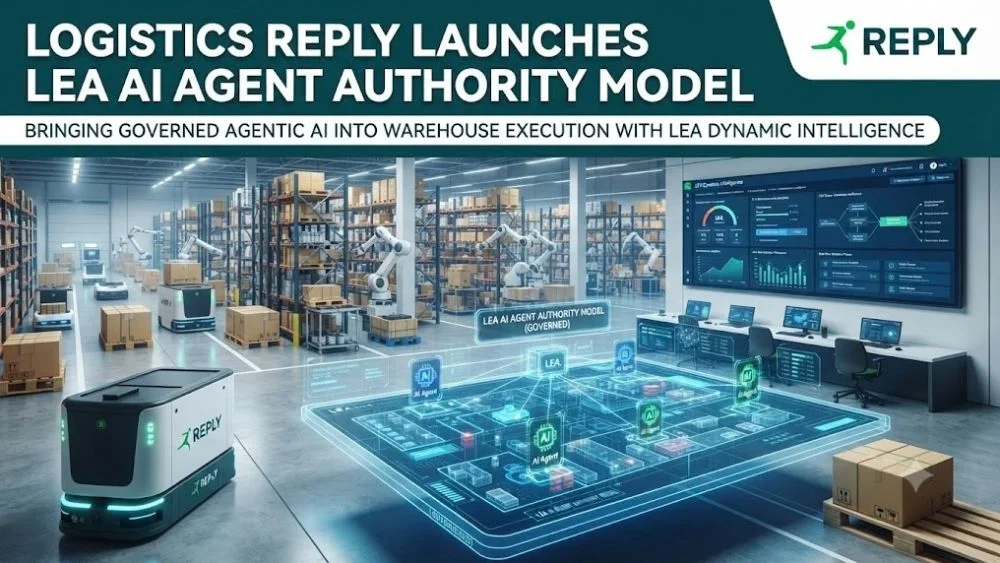
Logistics Reply has unveiled the LEA AI Agent Authority Model. The Reply group company specializes in innovative solutions for supply chain execution and warehouse management. The new practical framework arrives alongside LEA Reply Dynamic Intelligence. It helps organizations deploy AI agents with the right authority for each task, rather than maximum autonomy.
As AI moves from assistance into live warehouse execution, companies need a governed method to set agent authority. Without clear criteria, adoption can stall. Moreover, it can place additional risk on operational teams. The aim is to give agents authority that suits each task. After all, the ability to act does not, on its own, justify permission to do so.
How the LEA AI Agent Authority Model Works
The LEA AI Agent Authority Model addresses this challenge by combining two dimensions: organizational AI maturity and contextual agent authority. It pairs four maturity stages, from early adoption to mature, with five authority levels. These levels are Inform, Recommend, Act, Coordinate and Governed Autonomy.
Therefore, organizations can identify where AI creates value today. They can also decide what agents should do, where, and under which guardrails. The decision rests on the use case, context and risk. Furthermore, companies can extend authority as operational evidence and trust develop.
LEA Dynamic Intelligence supports the LEA AI Agent Authority Model framework with pre-built agents and an agent builder. Customers use the builder to create and deploy agents tailored to their needs. As a result, the model’s guidance on maturity and authority connects directly with practical warehouse operations.
Five Pre-Built Agents Target Recurring Warehouse Tasks
Five new pre-built agents become available from 5 October 2026. They address recurring warehouse tasks without requiring custom development. Each agent has its own data contract and integration approach. In addition, each one operates with delegated authority and human oversight suited to its task and operational context.
- Out of Stock Agent: It identifies the causes of stock unavailability. It also distinguishes actual shortages from temporary issues. As a result, teams face fewer delays and manual checks.
- Labor Distribution Agent: It supports real-time workload balancing. The agent identifies bottlenecks and estimates the effort needed to meet cut-off times. Then it recommends workforce reallocation.
- ABC Rebalancer Agent: It recalculates ABC classification based on movement data. The agent then generates a reclassification report. Upon approval, it writes the updated classes back to the warehouse management system (WMS) item master.
- Dock Scheduling Agent: It lets planners and carriers search for and book dock-door slots. They use natural-language conversation. Guided dialogue takes scheduling rules into account.
- Lost & Found Agent: It triggers when a task runs late. The agent can use camera input to assess the environment. It identifies causes of delay. It also detects issues, such as an item blocking an autonomous mobile robot (AMR) route.
“AI is creating enormous expectation, but also genuine uncertainty. Many teams know they want AI but are not sure where it should sit in daily operations or how to adopt it safely. AI maturity is organizational; agent authority is contextual. Our role is to help customers understand where AI can create value today, what level of authority is appropriate for each operational decision, and how to increase that authority safely as trust and evidence develop,” said Enrico Nebuloni, Executive Partner at Reply.
Explore IT Tech News for the latest advancements in Information Technology & insightful updates from industry experts!
News Source: Businesswire.com