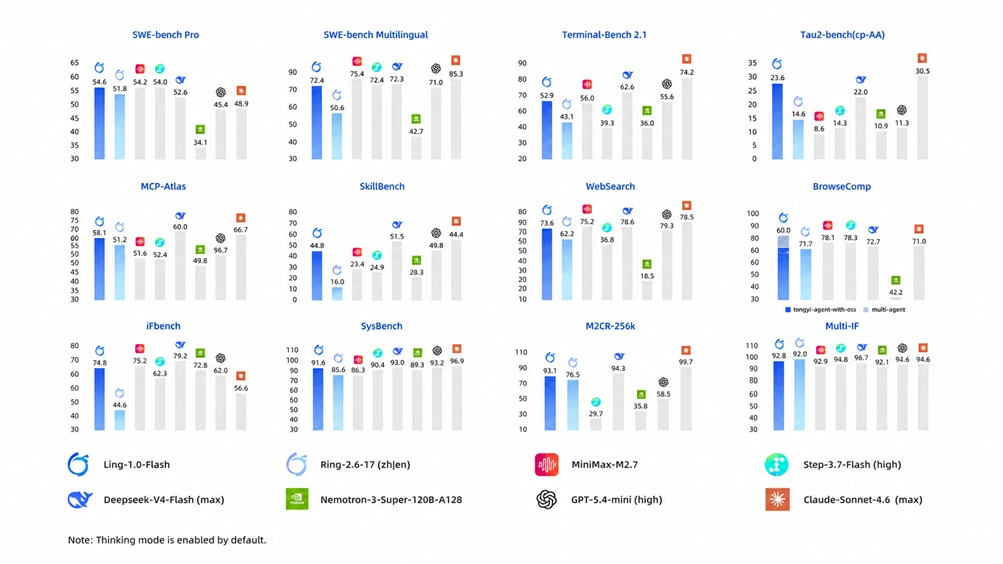
In the AI space, Ant Group has introduced Ling-3.0-Flash, its latest foundational model for production-level AI applications. The Ling-3.0-Flash model provides faster execution, better reasoning and lower operating costs. In addition, Ling-3.0-Flash is designed to power AI agent workflows that require speed, reliability and smart task execution in enterprise environments.
Ant Group built the new model on an original hybrid-reasoning architecture rather than continuously increasing the number of parameters like traditional large language models. The company therefore aimed for the highest possible intelligence density while remaining cost-efficient for real-world deployment.
The model contains 124 billion parameters in total, but only 5.1 billion parameters per token during inference time. This yields a competitive performance with a much smaller active parameter footprint. Ant Group said the model was on par with or better than AI models with two to three times more parameters on major industry benchmarks.
These benchmarks include basic reasoning, instruction following, and long-context understanding. This allows enterprises to deploy AI applications that balance computational efficiency and high-quality responses.
Hybrid architecture improves efficiency and reasoning capability
Instead of adopting the typical industry scaling approach, Ant Group designed Ling-3.0-Flash with a native hybrid-linear attention architecture. The framework interleaves KDA (Kimi Delta Attention) layers and MLA layers with a ratio of 5:1. Thus, the model keeps good long-context ability while maintaining important state memory.
One of the biggest gains is because of the improved KDA mechanism. The technology extends the previous Lightning Attention architecture by adding fine-grained diagonal gating in the Delta Rule state updates. This means the model can retain more relevant information when handling long documents and large software codebases.
Ant Group also enhanced the model’s Mixture-of-Experts (MoE) computing strategy. We have reduced the expert activation ratio per token from 1/32 to 1/64, leading to a significant improvement in computational efficiency while keeping the quality of the output.
The model also supports native 256K context window, and can scale to one million tokens effortlessly. That means businesses can handle far larger sets of data and more complicated reasoning tasks in a single workflow.
The Ling-3.0-Flash is built to complement modern AI agent ecosystems, not replace ultra-large reasoning models. Instead, it is a fast, stable and cost-controlled execution engine that enables the growing planning-execution separation model.
Ant Group improves AI agent workflows with engineering upgrades
Ant Group upgraded Ling-3.0-Flash with more than 10,000 interactive environments to support enterprise AI deployments. Thus, the model has better self-correction ability and long-horizon planning ability in challenging business scenarios.
The advanced training allows the model to autonomously perform complex coding tasks, break down tasks, and perform deeper research across multiple sources. Furthermore, it reduces the context loss and execution drift that are common in traditional AI models during long-term operation.
Beside the model architecture, Ant Group has also introduced a number of engineering improvements to boost production performance. In long conversations, multi-turn interactions may be computationally redundant. Therefore, a cluster-level hierarchical caching system can avoid this. This reduces the Time-to-First-Token (TTFT) for long inputs by 60% to over 80%, drastically improving user responsiveness.
The company also enhanced its multi-agent collaboration architecture for greater reliability. AI agents can now cross-validate outputs and split responsibilities throughout the workflow. This helps organizations to decrease the risk of incorrect decisions that may be made by a single model and increase the trust in AI-driven services.
The cooperative architecture also provides more stability for high-frequency online applications, which need stable performance under heavy load. Ant Group combines the latest in reasoning, efficient architecture, long context processing and enterprise-grade engineering to make Ling-3.0-Flash a practical solution for organizations looking to deploy scalable AI agent workflows across modern digital environments.
Explore IT Tech News for the latest advancements in Information Technology & insightful updates from industry experts!
News Source: Businesswire.com