TL;DR
- AI makes the analysis faster, but with speed approval and judgement is also crucial.
- When the outputs generated by AI are considered the right answer, people often move away from the decisionmakers.
- AI is expert in recognizing the patterns in past data, but it also lacks the love experience and intuition
- Critical thinking, problem framing, and independent analysis weaken when they are no longer practiced.
- Build expected human review, explainable outputs and real AI literacy into workflows, and let leaders model curiosity, skepticism and accountability.
Few technologies in recent memory have generated as much excitement and anxiety as artificial intelligence. One headline promises unprecedented productivity. The next warns of widespread cognitive decline. Both make good clicks, and neither tells the whole story.
The quieter, more useful truth sits in the middle: AI is not going to replace human thinking by default. But if individuals and organizations lean on it uncritically, replacement can happen by choice rather than by inevitability. Nobody announces that moment. It arrives one unquestioned recommendation at a time.
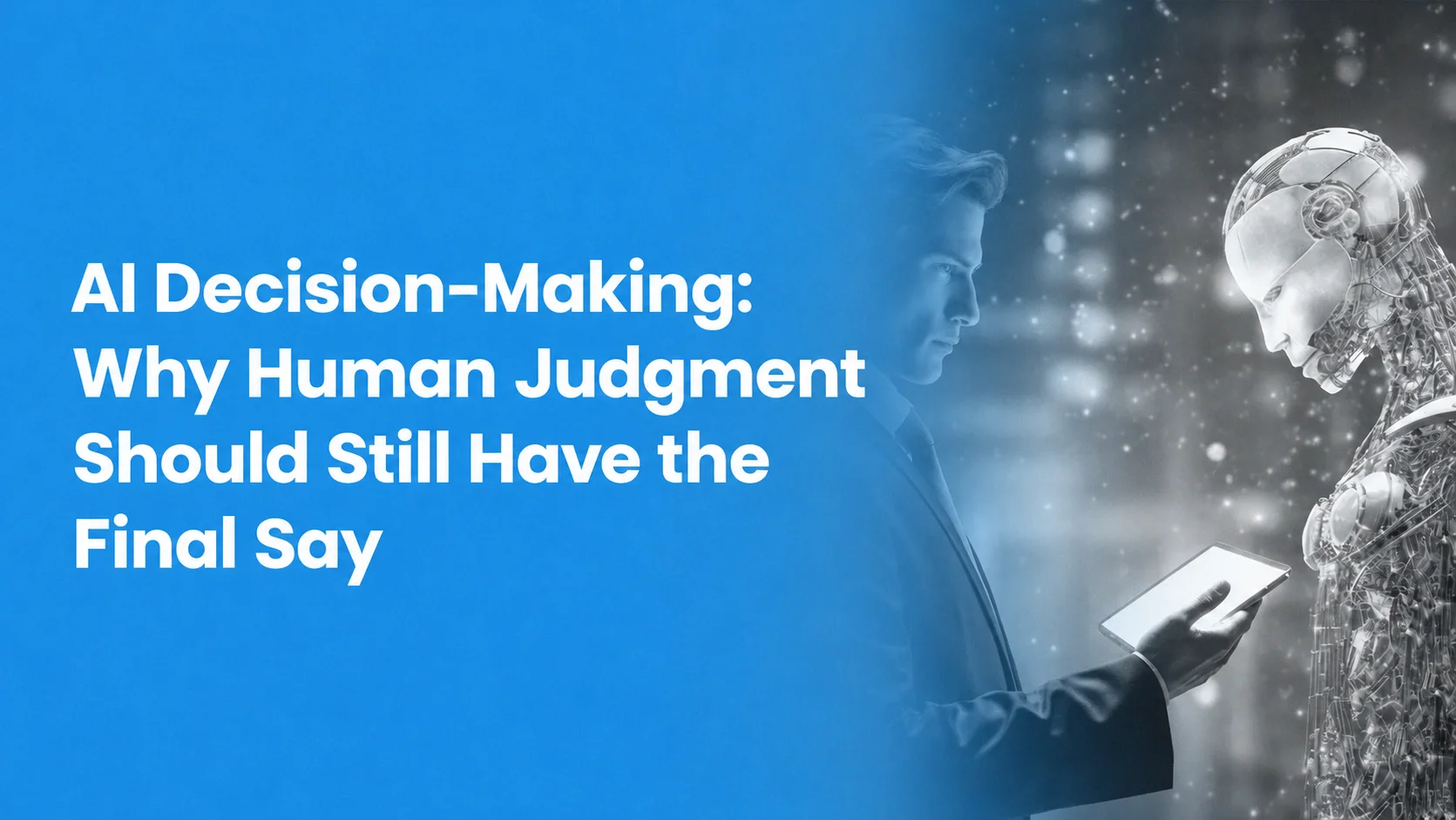
That is why the quality of AI decision-making depends far less on the sophistication of the model than on the habits of the people using it. This guide looks at where AI genuinely helps, where it falls short, and how enterprises can keep humans firmly in charge of the choices that matter.
Executive Insight:
| The danger is not that machines will take decisions from us. It is that we will hand them over because it is easier. |
How Is AI Decision-Making Changing the Way Enterprises Operate?
AI systems now sit inside a surprising number of business workflows. They score leads, flag anomalies, forecast demand, prioritize support tickets, recommend pricing and trigger automated actions without waiting for anyone to click a button. In many cases, the gains are real. Leaders can surface insights that would have taken analysts weeks to produce by hand, and teams can respond to complex situations in hours instead of days.
From Insight Engine to Default Authority
The shift usually begins innocently. A tool offers a recommendation, the recommendation proves useful a few times, and trust builds. That trust is healthy up to a point. The trouble starts when consistent accuracy turns into assumed accuracy, and the output stops being one view among several and becomes the view.
The Quiet Move From Decision-Maker to Approver
This is where the human role changes without anyone noticing. Instead of weighing evidence and forming a judgment, people begin reviewing a conclusion that has already been drawn for them. Review becomes a formality, and approval becomes a reflex. Over time, teams stop questioning results even when the surrounding context suggests they should.
At that point, the technology has moved from the support system to crutch. Adoption without intention can train people to disengage from the very thinking the business depends on.
What Are the Real Limits of Artificial Intelligence?
Despite the polished interfaces and confident tone, AI remains fundamentally limited. It does not understand the meaning of the way people do it. It holds no values, no intuition and no lived experience. What it does well is recognize patterns, optimize toward a target and generate probabilities based on data from the past.
These strengths are also the source of weaknesses. Knowing where the boundaries lie becomes more important as AI is given more authority.
Pattern Recognition Is Not Understanding
A model can tell you that customers with a certain profile tend to churn. It cannot tell you why a particular long-standing client is quietly frustrated after a difficult conversation with your account manager. The first is statistical regularity. The second is human context, and it often decides the outcome.
Where Context Gaps and Ethical Questions Break the Model
AI struggles when information is incomplete, when ethical considerations are involved, or when a decision affects people in ways that cannot be reduced to a metric. Should a restructuring plan prioritize cost savings or team stability? A system can estimate probabilities, but it cannot carry the moral weight of the answer.
When History Stops Predicting the Future
Models learn from what has already happened. When conditions change sharply, whether through a market shock, a regulatory shift or a competitor doing something new, the patterns they rely on can stop applying. The output may look just as confident as before, which makes the failure harder to spot.
When people forget these limits, outputs are mistaken for truth rather than interpretation. That single confusion is behind many of the worst outcomes of AI-driven decisions.
Why Does Human Intelligence Still Matter in an AI-Driven Workplace?
Human intelligence brings judgement shaped by experience which AI cannot replicate. People read nuances. They sense when a number does not match what they are seeing on the ground. They understand social dynamics, reputational risk, and the moral consequences of a choice.
These qualities matter most where the stakes are highest, in leadership, strategy, and any decision that is hard to reverse.
Judgment Built on Experience and Responsibility
An experienced operations head can look at a forecast and say, “This doesn’t feel right.” That instinct is not magical. It is years of pattern recognition fused with accountability, because the person knows they will answer for the result. A model has no such stake. It will not lose sleep, face the board or explain itself to affected customers.
Treating AI as an Input, Not a Conclusion
The most effective organizations use AI to widen the field of options and sharpen the questions, then keep final judgment with people. They ask the system for possibilities, scenarios and risks, and they use human insight to choose among them.
Executive Insight:
| AI works best when it sharpens human intelligence, not when it dulls it. |
This balance means technology enhances thinking instead of replacing it. It also keeps the organization capable, because the people making calls are still practicing the craft of making calls.
What Is the Hidden Risk of Over-Reliance on AI?
One of the least discussed consequences of widespread AI use is cognitive complacency. When a system reliably produces answers, people gradually stop practicing the skills those answers replace. It happens the way a driver who always follows GPS slowly loses their sense of the city.
Skills That Fade Without Practice
Critical thinking, problem framing, and independent analysis are muscles. If a tool always frames the problem, always drafts the analysis and always proposes the solution, those muscles weaken. The team may look more productive in the short term while becoming less capable in the long term.
Speed Pressure in Enterprise Environments
In business settings, the risk is amplified. Teams who move fast under pressure often tend to accept all the decisions and recommendations of AI. They skip the judgement phase. Each unchallenged approval makes the next one easier. Over time, AI decision-making becomes the default path, not because it should be, but because questioning it takes effort.
A Failure of Use, Not of Technology
It is worth being fair to the tools here. This is not a failure of technology. It is a failure of how the technology is used. The same system that dulls one team’s thinking can sharpen another’s, depending on the habits, incentives, and expectations around it.
The takeaway is not to use less AI. It is to use it with your eyes open.
How Can Organizations Design AI for Partnership, Not Authority?
Avoiding over-reliance takes deliberate design. AI should be implemented as a partner in decision-making, not as an unquestioned authority. That is a workflow choice, a training choice and a cultural choice.
Make Human Review Expected, Not Optional
If review is optional, it will be skipped when things get busy. Build workflows where a named person is expected to evaluate AI outputs, record their reasoning, and document when they disagree. For high-impact decisions, require a second human perspective. The goal is not to slow everything down. It is to reserve scrutiny for the choices that deserve it.
Demand Transparency and Explainability
People cannot meaningfully challenge what they cannot see. Favor systems that show their inputs, confidence levels, and reasoning in plain language. When a recommendation arrives with no explanation, reviewers have little choice but to trust it or ignore it. Explainability gives them a third option: to engage with it.
Invest in AI Literacy
Employees need to understand not only how to operate AI tools but also how they work, where they fail and when to push back. AI literacy is becoming as essential as digital literacy once was. A team that knows a model can be wrong, and knows the typical ways it goes wrong, is far less likely to surrender its thinking to it.
Consider a few practical habits that build this literacy:
- Ask “what would change this answer?” Before accepting a recommendation.
- Compare AI outputs against a simple human baseline from time to time.
- Run short post-decision reviews that examine where the tool helped and where it misled.
- Rotate people through the work AI usually does, so the underlying skills stay alive.
Who Owns Accountability When AI Decision-Making Goes Wrong?
The answer must always be a person. Technology can inform a decision, but it cannot be held responsible for one. When something goes wrong and the explanation is “the system recommended it,” accountability has been quietly dissolved, and that is a risk no organization should accept.
Leadership Sets the Tone
Leadership plays a decisive role in how AI is used. When executives treat AI as a shortcut to certainty, that mindset filters through every team. When they model curiosity, skepticism and accountability, by asking tough questions of the output and openly noting where they overrode it, the organization learns that using AI well means thinking harder, not less.
Decisions That Should Never Be Fully Automated
In 2026, the most successful leaders will not be the ones who automate the most decisions. They will be the ones who know which decisions should never be automated. Strategy, ethics and long-term vision still demand human ownership. Hiring and firing decisions, choices that affect customer safety, and moves that define company values belong on that list.
Executive Insight: AI can inform strategy, ethics and vision, but it cannot own the responsibility for them.
A simple test helps: if you would be uncomfortable explaining a decision to the people it affects by saying “the algorithm suggested it,” a human need to own it fully.
What Does Choosing Augmentation Over Replacement Look Like in Practice?
The future of AI is not a contest between humans and machines. It is a question of how they work together. Organizations that treat AI as an augmentation of human intelligence build resilience, adaptability, and trust. Those that let it quietly replace thinking risk becoming dependent on systems they no longer fully understand.
In practice, augmentation tends to look like this:
- AI drafts, humans decide. The system proposes options, summarizes data, and flags risks. A person selects, adjusts, and signs off.
- AI scales, humans calibrate. The tool handles volume and repetition while people audit samples and watch for drift.
- AI explains human challenges. Outputs come with reasoning, and teams are rewarded for asking sharp questions rather than approving quickly.
- AI explains human challenges. Outputs come with reasoning, and teams are rewarded for asking sharp questions rather than approving quickly.
Over time, strong AI decision-making is not defined by how many tasks a system handles. It is defined by how clearly the organization understands what the system is doing and why. That understanding is a competitive advantage, and it only comes from people who stay engaged.
Conclusion: The Real Challenge Is Human
AI will keep getting faster, more capable and more woven into how organizations run. That is not the part to worry about. The part that deserves attention is what we do with it: whether we use it to sharpen our judgment or to avoid exercising it.
AI won’t replace your thinking on its own. But if you stop questioning, stop learning and stop taking ownership of decisions, it might not have to. The organizations that thrive will be the ones that keep curiosity, skepticism and accountability at the center of every important choice, using AI as a powerful partner and never as the final authority.
The real challenge here is not technological. It is human.
Want to keep your edge as AI reshapes the enterprise?
Explore more expert insights, trends and practical guidance on AI, technology and leadership by reading more blogs on IT Tech News today.
Frequently Asked Questions
1. Will AI replace human decision makers?
It should not. The technology is good at analyzing information and identifying patterns, but it cannot evaluate decisions based on judgment and values, so its replacement can occur only by default in an environment where humans do not ask probing questions.
2. How can leaders avoid overreliance on AI?
They can make human judgment a mandatory element in the decision-making process, rely on models that are easy to understand, invest in building employees’ AI literacy and critical thinking, and set aside decisions that should not be made by machines.
3. What is the difference between AI augmentation and AI replacement?
The former assumes that the technology serves as an enabler of better human decisions, while the latter means that the responsibility of choosing an option and taking action falls entirely on the system.
4. What decisions should always be made by humans?
Those that involve ethical matters and require judgment about the possible consequences for people, livelihoods, and safety and have to do with long-range strategic choices and core values.
5. How can teams begin to develop AI literacy?
They can start by acquiring at least some fluency with the technologies, studying their limitations and possibilities, and creating routines that make them question recommendations, compare results with their expectations and those of their colleagues, and examine all conclusions closely.