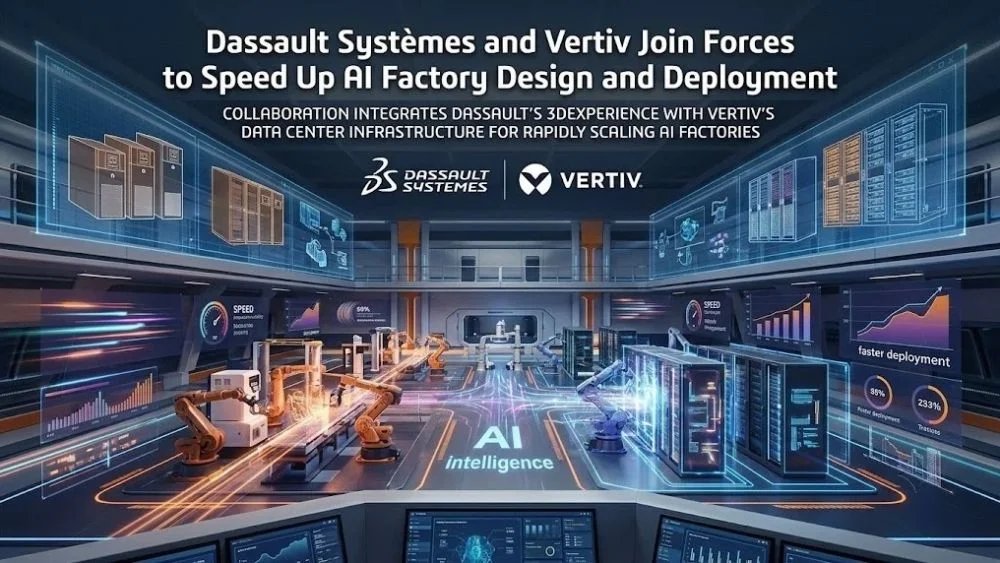
Dassault Systèmes and Vertiv Holdings Co. announced a new collaboration today. The partnership lets teams configure, simulate and validate AI factory infrastructure before construction begins.
The companies combine Dassault Systèmes’ 3DEXPERIENCE agentic platform with Vertiv’s critical digital infrastructure expertise. As a result, they aim to reduce field complexity. They also want to shorten the path from design kickoff to productive AI capacity for NVIDIA DSX AI factories.
The collaboration builds on the Vertiv SmartRun configurable virtual twin. Moreover, it extends the model-based approach to broader Vertiv AI factory infrastructure solutions, including Vertiv OneCore. The 3DEXPERIENCE platform supplies systems engineering, simulation and virtual twin capabilities. Engineers use these tools to configure and validate Vertiv’s pre-engineered SimReady power and cooling reference designs. These designs rely on the NVIDIA Vera Rubin DSX AI Factory reference design and the NVIDIA Omniverse DSX Blueprint.
Why AI Factory Infrastructure Needs a Systems View
AI factories work as highly coupled systems. Power, cooling, network, controls and compute must be engineered together. A change in one domain can trigger significant downstream effects in others. Therefore, engineers must understand how a complete infrastructure system will perform before teams build and deploy it.
Vertiv OneCore is a hybrid-built data center solution. It integrates critical power, thermal management and supporting infrastructure. The 3DEXPERIENCE platform represents this infrastructure as an integrated digital system. In addition, it gives teams traceability and visibility into the impact of design changes.
Vertiv SimReady power and cooling assets become configurable system models on the platform. These models serve as the starting point for customer-specific AI factory configurations. Rather than creating a fixed design, engineers evaluate configurations and propagate design changes across disciplines. They also perform system-level and multiphysics validation. Finally, they generate engineering deliverables from a common environment.
This approach moves engineering toward configurable, continuously co-designed and validated AI factory infrastructure. It preserves design intent from early configuration through construction, commissioning and future technology upgrades.
Targeted Customer Outcomes and Executive Views
Targeted customer outcomes include speeding up the path from requirements to a configured and validated AI factory solution by up to 10x. Additionally, the approach can cut the defined infrastructure deployment period by up to 50%. Under the assumptions in Vertiv’s model, the combined approach can bring capacity online approximately 10 weeks sooner than a modeled conventional baseline. Consequently, it produces up to 30% more cumulative token output within 12 months of project kickoff at the same installed capacity. However, the gain results solely from earlier facility readiness. It does not reflect improved operating efficiency or a measured customer result.
“The winners in AI will be those who can turn computing capacity into productive capacity fastest,” said Scott Armul, Chief Product and Technology Officer. “That requires the entire AI factory to work as one system, across compute, power, cooling and physical infrastructure. By combining Vertiv’s pre-engineered infrastructure expertise with Dassault Systèmes’ model-based capabilities, we can configure and validate that system before construction, reduce complexity in the field and help customers bring AI capacity online faster.”
“AI factories are among the most complex engineered systems being built today. That complexity demands a systems view — modeled, simulated, orchestrated and optimized in a virtual twin, before the entire factory is built,” said Elisa Prisner, Executive Vice President, Strategy, Industry, Marketing and Transformation, Dassault Systèmes. “Together with Vertiv, we are transforming standardized infrastructure knowledge into configurable virtual twins for NVIDIA DSX AI factories. Our 3DEXPERIENCE platform allows customers to explore configurations, understand the consequences of design decisions, and validate the performance of an entire system virtually, before any infrastructure exists physically.”
At NVIDIA GTC Berlin, Oct. 20-22, the companies will showcase elements of the design and deployment approach. The demonstration will show how facility requirements inform infrastructure configuration. It will also show how teams can evaluate power and cooling constraints virtually. Furthermore, Vertiv will demonstrate how it applies factory-built infrastructure to accelerate physical deployment. The showcase brings together the NVIDIA Vera Rubin DSX AI Factory reference design, the NVIDIA Omniverse DSX Blueprint, Dassault Systèmes’ 3DEXPERIENCE platform and model-based systems engineering capabilities, and Vertiv SimReady power and cooling assets.
Explore IT Tech News for the latest advancements in Information Technology & insightful updates from industry experts!
News Source: Businesswire.com