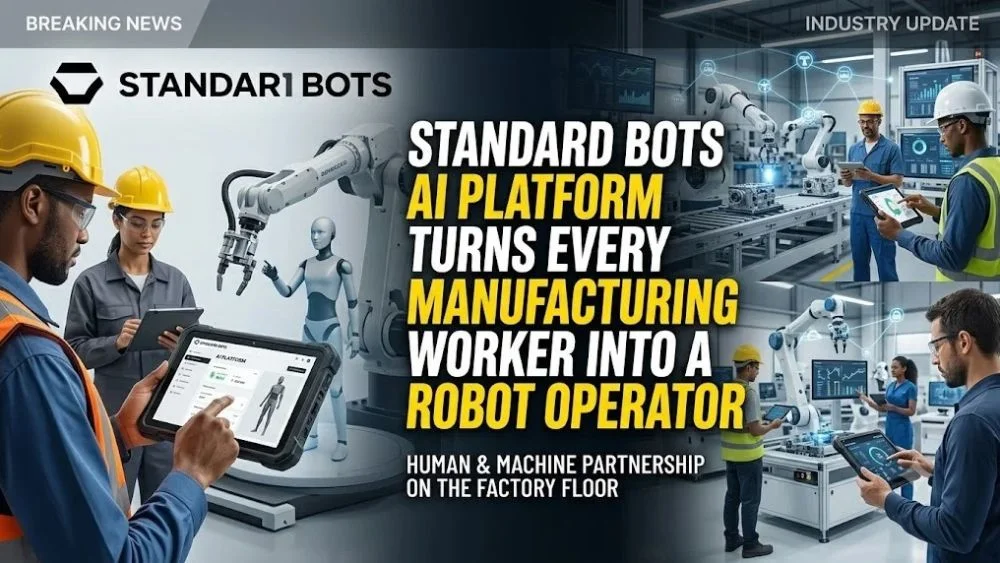
Standard Bots, America’s largest manufacturer of AI-native industrial robots, has launched its new Standard Bots AI platform. The platform features three skills: Agent, Locate, and Inspect. These skills let frontline workers program a robot for complex tasks within minutes. Workers need only an iPad. They need no code, no fixtures, and no outside integrator.
“Our mission is to enhance human capacity with the world’s most accessible robots.” – Evan Beard, Co-Founder and CEO, Standard Bots
Why Manufacturing Automation Matters Now
Small manufacturers dominate the American industrial landscape. According to the National Association of Manufacturers, nearly 200,000 of the country’s 240,000 manufacturers employ fewer than 20 people. Meanwhile, Deloitte and the Manufacturing Institute report that the industry could need 3.8 million new workers by 2033. Of those jobs, 1.9 million could go unfilled.
Robots offer Standard Bots AI platform manufacturers a practical way to meet rising demand despite labor shortages. They also improve safety standards for frontline workers. However, only 6% of U.S. manufacturers use robots today.
Evan Beard, Co-Founder and CEO of Standard Bots, said: “Until recently, robots have been dumb and brittle. They’ve been expensive to install and service, required third-party consultants to hard-code every motion, and still couldn’t do that much. Standard Bots AI is changing all of that. Manufacturing workers can automate tasks just by prompting their robot to make a routine and learn from simple demonstrations. Standard Bots deploy and pay back twice as fast as the industry standard. Our mission is to enhance human capacity with the world’s most accessible robots.”
Agent: Build and Change Routines by Prompt, Not Code
Agent is a Standard Bots AI skill that users simply talk to. Operators tell it what the robot should do, and it builds the routine. Standard Bots trained Agent on its user manuals and best practices. For example, a user can type “Build me a machine tending routine.” Agent then asks about the setup and builds the program alongside the user. The experience resembles how ChatGPT or Claude assists with digital work.
As a result, operators can describe a task and deploy a working program quickly. They need no software or robotics experience.
Locate: Tap or Type What to Look For, and It Remembers
Locate removes the most tedious steps of robot programming. Traditionally, programmers define exact coordinates by hand. They repeat this for multiple joints across many waypoints. With Locate, operators simply tap any object in the robot’s video feed. They can also describe it in text. The robot then locates, tracks, and moves around the object on its own.
Consequently, Standard Bots AI platform routine setup becomes faster. Teams also skip fixturing and part presentation. They just roll parts over from upstream processes and start working.
Locate cuts programming time by 90%. Operators no longer dial in a grid of waypoints. This change opens the door to high-mix work, where parts on the line keep changing. Changeover is trivial for a human. However, it has been prohibitive for legacy robots, because change once meant painful reprogramming and re-fixturing. Now, users just ask Standard Bots AI to locate the new parts. This benefits the world’s largest companies and the smallest single-person job shops. Some of those shops run 25 different parts a day on a single machine.
Inspect: Catch Defects in Real Time
Inspect helps manufacturers catch defects on their parts. It uses custom vision models trained on a customer’s own parts. These models find flaws such as scratches, including subtle ones that are hard to see with the naked eye. Standard Bots developed Inspect in partnership with Roboflow. Operators can natively load their custom inspection models into the platform and use them in their routines.
The robot scans part surfaces and flags every defect it finds. Teams can then step in, or they can let the robot handle what it sees on its own. In addition, Inspect adds automated quality checks in-line or at a dedicated station. Manufacturers do not need to hire a machine vision expert. Setting up a custom model is fast and simple.
Expanding Human Capacity With Accessible Robots
Customers can also bring their own models instead of staying locked into one vendor’s stack. Meanwhile, Standard Bots continues to develop its own foundation models.
Leif Jentoft, Head of Applied AI at Standard Bots, said: “You used to have to hire an integrator; it costs a million dollars. You spend months dialing it in. And when something breaks in the middle of the night, you can’t fix it yourself. It’s like a literal black box on your own shop floor. With Standard Bots AI, you don’t have to program every position or keep track of where you are in a routine. You simply show your robot what you want it to do, and it will adapt to higher-mix tasks with simpler, more reliable programs.”
Adrian Nistler, President and CEO of Path Machining Automation, a contract machining company in the Minneapolis-St. Paul area, said: “We chose Standard Bots for two reasons: the speed of development is highly compressed, and the interface for programming the robot is so much simpler. With Standard Bots AI, that’s even faster. This is a big thing for American manufacturing because we can actually compete. Quality’s improved, on-time delivery is improved, and price competitiveness is improved.”
Explore IT Tech News for the latest advancements in Information Technology & insightful updates from industry experts!
News Source: Businesswire.com