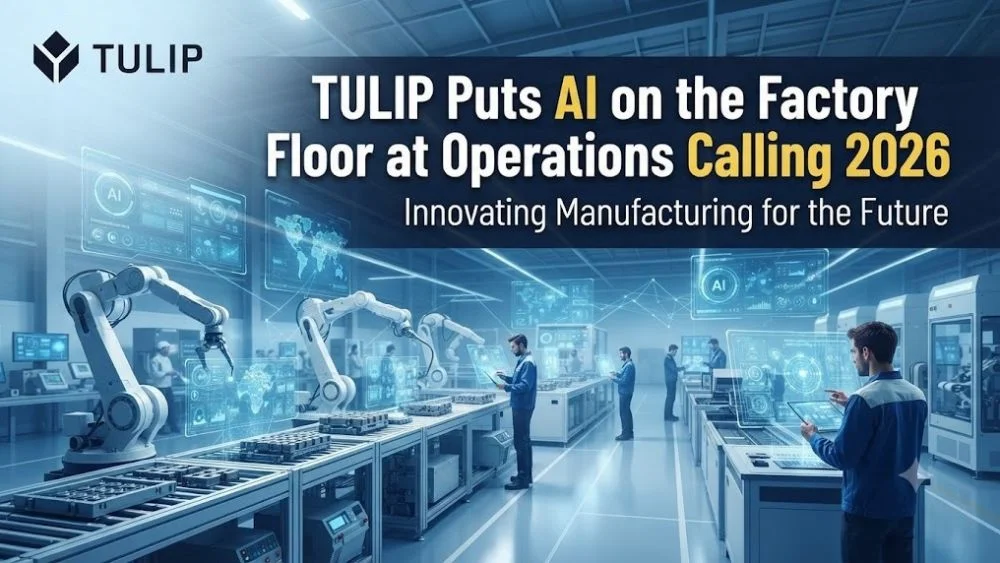
Tulip, the leader in Frontline Operations, announced a new set of capabilities today at Operations Calling 2026. The release puts AI on the factory floor for the people who run it. Operators and engineers can now build apps, agents, and automations in whatever way fits the job. Next, they can run and orchestrate those tools against live machine, vision, and operator data. Finally, they can scale what works across sites under shared governance.
Tulip introduced Projects, Industrial Connectivity, a Governance & Scalability Suite, Factory Playback, and Code based Apps. The company also launched new Frontline Deployed Engineer and Validation Accelerator services. As a result, manufacturers get one governed record of what AI reasoned on and what people decided.
Tulip’s Position: AI Exists to Unlock Human Potential
Tulip opened its keynote with a clear position. AI has one job, which is to unlock human potential. Humans are not going away. Instead, they will keep working differently and better, and the platform has to be built for them.
Meanwhile, AI on the factory floor has made it far easier for more people to write software. Consequently, the stakes rise on how that software is deployed. They also rise on what data it can touch and what an auditor sees later. Tulip’s answer is a set of composable building blocks that share one data model. Therefore, teams can add, update, or replace one block without regression-testing the whole production system.
Tulip CEO and Co-founder Natan Linder put the choice to manufacturers as two options. They can stay with legacy, monolithic platforms that market AI. Alternatively, they can move to a platform purpose-built with AI. “There is no Option 3.”
“A lot of industrial software is still selling the fax machine. It tells you there’s a problem, and then you wait on a vendor or an IT queue to change anything. What we showed today is a step function. An engineer lays out the whole production system in Projects, the Authoring Agent builds it with full context, and developers write code in their own tools when that’s faster. All of it runs in Tulip, at speed and under one governance model,” said Linder.
This year’s announcements follow the lifecycle of a production system. They fall into three stages: Build, Run & Orchestrate, and Scale.
Build: From Idea to a Running Production System
Every operation is different, and every operation keeps changing. For that reason, Build focuses on speed to production in the way that fits the job.
Projects. Projects give teams one canvas to plan, see, and connect every app, automation, agent, table, and connector. Planning happens inside Tulip, right next to the apps and data the plan describes. Thus, teams see how the pieces fit together and what depends on what. The project is now entering customer testing.
Authoring Agent. The AI on the factory floor Authoring Agent works inside the project’s context. That context includes the apps, the data, and the SOPs behind the process. Before it drafts an app, it asks the questions an engineer would ask. For example, it asks whether a regulated step needs an electronic signature. Then it lays out its build plan for the engineer to review. In short, engineers get more context and more control over what gets built, not a black box. The Authoring Agent is also entering customer testing.
Code based apps. Code mode lets engineers build custom frontline apps with their own IDEs and AI coding agents. The platform automatically enforces site portability, operator attribution, and zero-trust IT security. Moreover, it carries Git pull requests to the shop floor as frozen, fully audited versions designed for GxP environments. Code mode is now previewing.
Run & Orchestrate: One Operational Record, From Machine to Decision
Run & Orchestrate centers on the operation itself. It connects the floor, shows what happened, and puts people and agents to work on one shared record.
Industrial Connectivity. Industrial Connectivity is Tulip’s operational data layer. It brings machine data from existing drivers, historians, and UNS into Tulip. Then it joins that data with real-time human context at scale. Unlike platforms that stop at asset-tag modeling, Tulip ties machine data directly to the order, step, station, and operator. Therefore, it captures not just what the machine did, but what the human decided and why.
Factory Playback. AI on the factory floor Tulip introduced Playback with NVIDIA last year. It gives factories eyes and the ability to act on what they see. The feature turns local edge server camera streams and advanced vision-language models into a complete, replayable history of the floor. In addition, new human activity detection shows where time goes. It also shows whether a procedure was followed and whether a part was assembled to spec. As a result, teams see exactly what happened and find root causes faster. They also stop digging through hours of footage.
Composable AI Agents. Tulip introduced Composable AI Agents at Operations Calling 2025. Now, teams can use them in even more floor operations. Each agent keeps a preserved operational record for human-in-the-loop quality assurance.
Native support for MCP Connectors. Tulip will natively support Model Context Protocol (MCP) connectors that work in both directions. External AI tools and coding agents can read from and act on Tulip apps, tables, and workflows. Likewise, Tulip agents can call external systems the same way.
Scale: Agility That Passes an Audit
Scale is about governance. It carries what works from one site to every site without starting over. Furthermore, it does so without giving up control.
Enterprise Library. Enterprise Library is a single library of apps and other assets. It lives on a customer’s Center of Excellence instance. Companies publish once, and sites download. Hence, a standard built in one place reaches every site. Enterprise Library launches later this year.
OpsMoto. OpsMoto is now one year old, and it gives enterprise teams full visibility across all their sites. A new AI chat interface lets users ask questions about operational data in natural language. The tool then builds the queries and datasets automatically, which speeds up decisions.
“Manufacturers don’t need more tools; they need ways to move faster without sacrificing governance. Our focus this year is giving people AI grounded in their factory’s real-world context, so engineers decide, agents draft, and the work stays auditable as it scales,” said Mason Glidden, Chief Product and Engineering Officer at Tulip.
Services and Expertise: Frontline Deployed Engineers and Validation Accelerator
Tulip is also launching two services that place its own engineers and quality experts inside customer operations. Alongside them, the company is adding new Library Resources for teams that want to jumpstart system design.
Frontline Deployed Engineers (FDEs). Tulip engineers embed with a customer’s operations team to deliver working systems on the plant floor. They build alongside site staff. Consequently, local engineers understand, own, and adapt the software after deployment. Tulip already has FDEs deployed across customer sites globally.
Validation Accelerator Services. This service helps life sciences companies simplify, scale, and accelerate GxP validation across their operations. Tulip Validation experts evaluate existing SOPs. After that, they deliver customized validation plans, practical applications or agent artifacts, and actionable risk-management strategies. The offering bridges modern digital workflows with strict regulatory standards. Thus, it supports faster, compliant deployment.
AI Adoption Workshops. These are on-site, hands-on sessions. Tulip experts work directly alongside customer engineers inside their own Tulip instance to build production-ready agents. First, participants complete prerequisite training through Tulip University. Then they bring quantified shop-floor challenges, such as defect review, shift handoffs, quality data analysis, and launch-readiness checks. Together, the teams build, test, and deploy auditable AI agents with human oversight built in from day one.
Tulip Federal. Tulip Federal is a practice dedicated to manufacturers in America’s defense industrial base. It also serves federal production and sustainment operations. It helps primes, suppliers, and government sites digitize assembly, inspection, quality, and maintenance work on the frontline. Afterward, they roll what works out across programs and sites.
Built Around the People Who Run the Floor
“AI has one job, to unlock human potential,” Natan Linder told the Operations Calling keynote audience. The customers who followed him made the same case from the floor. In regulated and craft-driven operations, the quality of the work still depends on what people know. Accordingly, the strongest results come when the technology is built around them.
Sarath Krishnaswamy, former VP of Operational Technology at Smith & Nephew, delivered the customer keynote. He described what it took for his teams to win: “When we were winning, it was because we were elevating people. Even the AI tools were just tools. People were a source of wisdom, they were the amplifiers, without [them], this would have been a complete disaster.” He was equally direct about what AI depends on: “…if you don’t have fundamental intelligence about what your operation is doing, you need to have wisdom, and wisdom comes from people. Unless you have that wisdom and a way for that wisdom to come out, the AI tools aren’t going to do anything.”
At Tiffany & Co., artisans make jewelry by hand, and training once took years. Steve Saulen, Director of Manufacturing, described the workforce at one facility. He also explained what AI now does for the people who supervise it: “We have over 500 skilled artisans at our closest facility… with anywhere from several months of experience up to forty years. Not long ago, we weren’t even using AI, and now we have … a production analyzer agent where the frontline supervisors can actually ask, ‘Who is my most proficient artisan at this product? If I had a rush order that was due in 24, 48 hours, who should I give it to? Who needs retraining?’” Saulen described how agents are also being used for predictive analysis, “It will also then tell you, ‘Here’s my recommended training plan. Here’s what you need to look into. Here’s some additional insight into your operation.'”
Explore IT Tech News for the latest advancements in Information Technology & insightful updates from industry experts!
News Source: Businesswire.com