
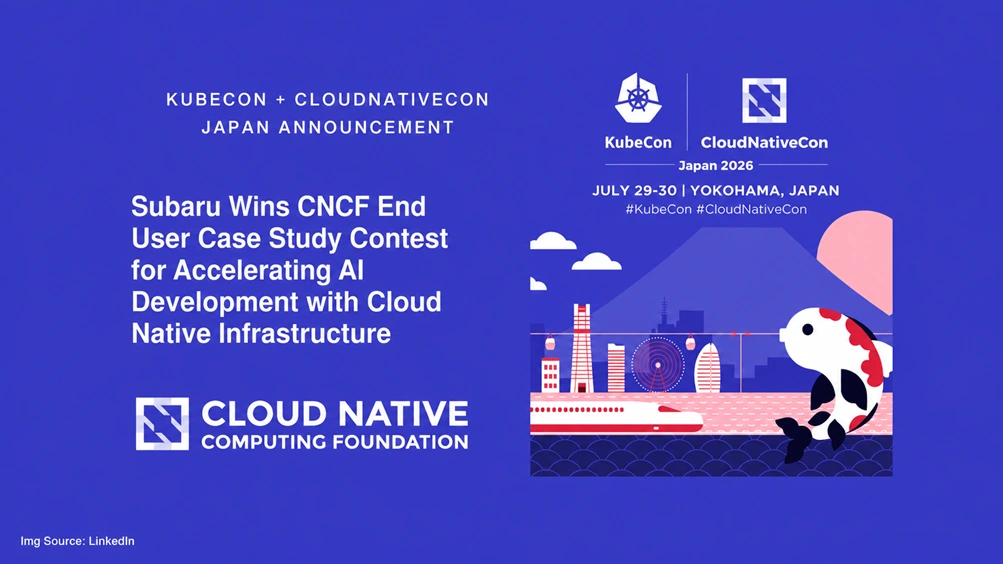
Earning the CNCF End User Case Study Award, Subaru transformed its AI development platform with cloud native technologies. Following infrastructure modernization, Subaru won the CNCF End User Case Study Award to improve AI development efficiency. Recognized for using Kubernetes and CNCF projects, Subaru accelerated machine learning workflows for its next-generation EyeSight Advanced Driver Assistance Systems. Subaru has been named the winner of the CNCF End User Case Study Contest by the Cloud Native Computing Foundation (CNCF) at KubeCon + CloudNativeCon Japan 2026 in Yokohama, Japan. The recognition highlights Subaru’s successful adoption of cloud native technologies. The company has leveraged these technologies to enhance developer productivity and optimize infrastructure performance. It has also improved machine learning reproducibility through its cloud native initiatives.
Subaru was given the award after it overhauled the AI infrastructure that underpins the development of its next-generation EyeSight Advanced Driver Assistance Systems (ADAS). The company also integrated Kubernetes with a host of CNCF technologies including Envoy Gateway, Gateway API and MetalLB. This enabled Subaru to greatly enhance the performance and scalability of its AI development platform.
One of the most discussed achievements was the optimization of delivering AI container images over 30 GB. Previously, engineers had to wait for image downloads for almost three hours before they could even start workloads. But Subaru overhauled its Kubernetes networking architecture with Envoy Gateway and cut down image pull times to about three minutes. This has resulted in a remarkable 60-fold improvement for the company, enabling developers to initiate AI workloads much faster.
Subaru also strengthened its process for deploying software by embracing GitOps practices. The company used Argo CD with Helmfile to standardize application deployment and increase reproducibility across AI development environments. This provides engineering teams with consistent management of application definitions and reduces the complexity of deployments.
“As organizations build increasingly sophisticated AI applications, cloud native technologies provide the foundation for making those workloads scalable and operationally efficient,” said Chris Aniszczyk, CTO, CNCF. “Subaru demonstrates how combining Kubernetes with projects like Argo, Envoy, Helm, Harbor and MetalLB can solve real world infrastructure challenges while accelerating AI innovation. It’s an excellent example of open source cloud native technologies delivering measurable business impact.”
Cloud Native Technologies Improve Subaru’s AI Development
Developing AI models for Subaru’s next-generation EyeSight platform requires continuous data processing, model training, validation, and inference. Nevertheless, the company’s previous on-premises GPU infrastructure struggled to support increasingly complex AI workloads. Large AI container images delayed development, while manual deployment scripts reduced operational consistency. Additionally, the absence of a unified orchestration framework limited machine learning reproducibility.
“We wanted to build an AI development platform that removed operational friction and enabled our engineers to focus on improving model accuracy instead of managing infrastructure,” said Ryoji Kobayashi, DevOps engineer of ADAS development department, Subaru. “By embracing cloud native technologies and GitOps practices, we’ve significantly reduced development bottlenecks while creating a more reproducible, scalable platform for machine learning. The improvements we’ve achieved are helping us accelerate innovation for next-generation EyeSight.”
To tackle these challenges, Subaru leveraged a full cloud native AI platform based on Kubernetes and a number of CNCF technologies. The company also employed Argo Workflows to automate end-to-end machine learning pipelines, which increased operational efficiency and workflow reproducibility. This frees up engineering teams to spend more time building AI models rather than managing infrastructure.
Subaru plans to expand its use of Kubernetes and additional CNCF technologies as AI workloads continue to grow. The company also intends to increase developer productivity and expand platform capabilities. It will continue investing in cloud native infrastructure to improve operational efficiency.
Subaru officially announced its success during a keynote session at KubeCon + CloudNativeCon Japan. During the session, Ryoji Kobayashi presented the award-winning case study and demonstrated how Subaru’s cloud native transformation accelerated AI innovation.
Explore IT Tech News for the latest advancements in Information Technology & insightful updates from industry experts!
News Source: PRNewswire.com